
How to choose a CRM for a 5–50 person business
Start with the workflow, not the feature list
A CRM does not fix a broken sales process — it encodes whatever process you already have. So the first question is not "which CRM" but "what happens, step by step, from the moment a lead arrives to the moment money lands". Write that down. The gaps you find — the lead nobody followed up, the quote sent from someone's personal email, the deal that lived only in a manager's head — are your actual requirements. The tool comes second.
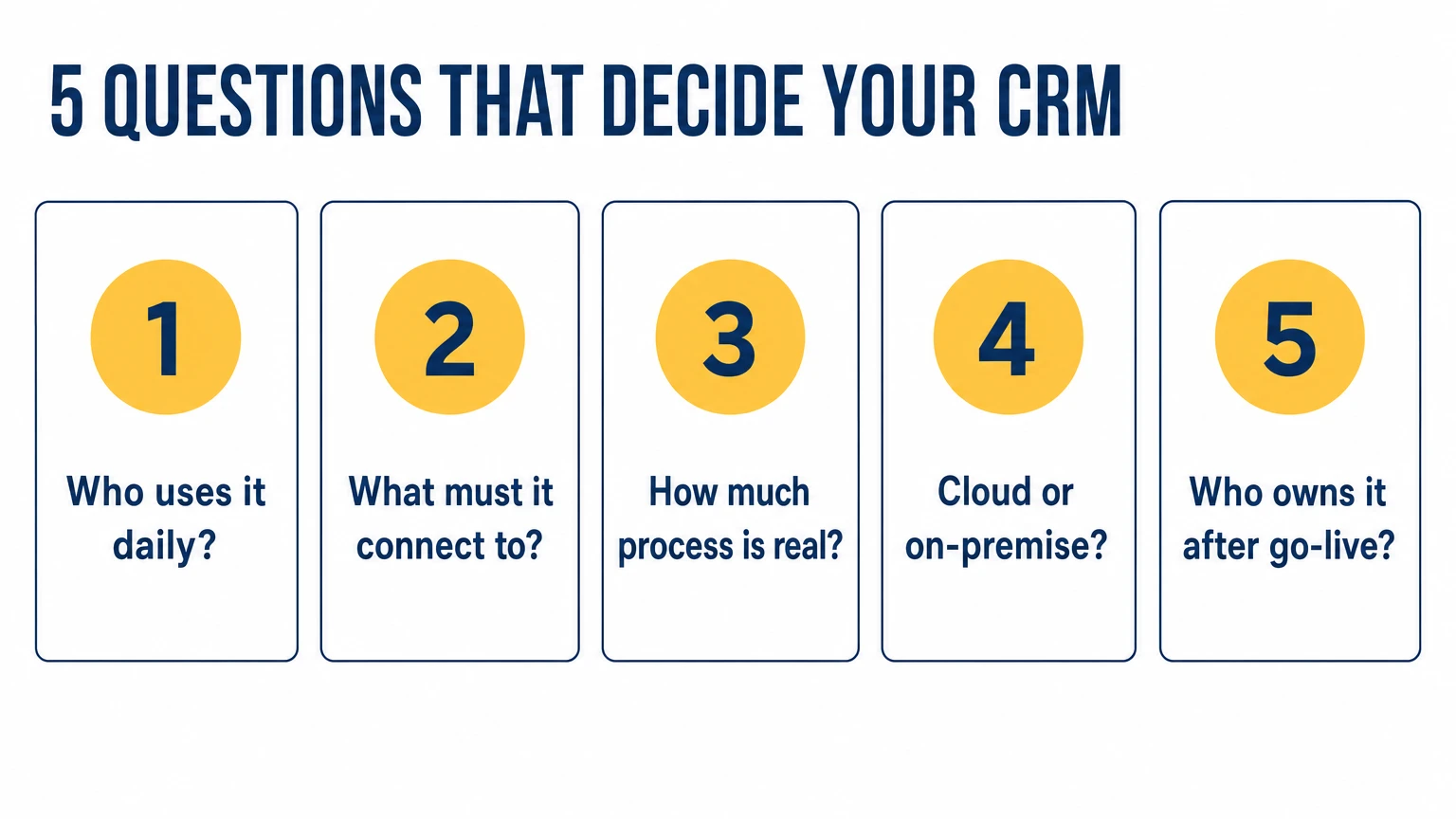
The five questions that actually decide it
- Who has to use it every day? If your people live on the phone, telephony and mobile matter more than dashboards. If they live in chat, messenger integration (WhatsApp, Viber, Telegram) is non-negotiable.
- What does it have to connect to? Your accounting, your website forms, your phone system, your inbox. A CRM that does not sync with the systems you already depend on creates double entry — the fastest way to kill adoption.
- How much process do you really have? A 6-person team usually needs one clean pipeline, not 40 custom fields. Over-configuration is the most common reason small teams abandon a CRM.
- Cloud or on-premise? Most teams should be on cloud. Choose on-premise only when data residency or regulation genuinely requires it — and budget for the maintenance it adds.
- Who owns it after go-live? A CRM without an internal owner drifts back to chaos within months. Decide this before you buy, not after.
Match the tool to the team, not the hype
There is no single best CRM for a small business — there is a best fit for your process. The tools we implement most often, and where each tends to fit:
- Bitrix24 — the widest scope (CRM, telephony, tasks, automation, on-premise option) for teams that want one system to run most of the business, especially when you need built-in telephony and would rather not stitch five tools together.
- Pipedrive — the cleanest pipeline for a sales-led team that wants to see and move deals without configuration overhead. Fast to adopt.
- monday.com — visual and flexible when sales, projects and operations share one board. Good for teams that think in workflows, not just deals.
- Zoho CRM — deep features at a low price point, strongest for teams already inside the Zoho ecosystem.
- Uspacy — a lightweight, modern portal for small teams that want something simple and affordable without enterprise weight.
- SendPulse — when the priority is marketing automation and multichannel messaging more than a classic sales pipeline.
The point is not the brand. It is that a sales-led 8-person team and an operations-heavy 40-person team should not end up on the same tool by default.
What "5 to 50 people" changes
At 5 people the risk is over-buying: you do not need enterprise features, you need one pipeline everyone updates. At 50 the risk flips — you need roles, permissions, reporting and automation, because what one person used to hold in their head now has to be a system. The CRM that fits at 5 often has to grow with you to 50, so weigh how the tool scales, not just how it starts.
The cost question
Licence price is the smallest number in a CRM project. The real cost is configuration, data migration and the time your team spends learning it. A realistic implementation for a 5 to 20 person team is measured in a few weeks and a four-figure setup, not an afternoon — and the payback comes from the leaks it closes (the lead nobody called, the deal that stalled unseen), not from the software itself.
How to run the decision in two weeks
- Days 1–3: map the lead-to-cash workflow and list the two or three systems the CRM must integrate with.
- Days 4–7: shortlist two tools that fit that workflow — not the five with the best ads.
- Days 8–12: run a real pilot with real data and the people who will actually use it, on one pipeline.
- Days 13–14: decide, name an internal owner, and plan the rollout in phases — three core features first, the rest as the team adopts.
Done this way, the choice stops being a gamble on a feature list and becomes a match to how your team already works. If you want a second pair of eyes, a free process audit maps what to automate first — and which CRM actually fits — before you commit a euro.
Frequently asked
What is the best CRM for a small business?
There is no single best — the right CRM is the one that fits your workflow and the systems you already use. A sales-led team and an operations-heavy team should choose differently. Map your lead-to-cash process first, then shortlist tools that match it; for most 5–50 person teams that is one of Bitrix24, Pipedrive, monday.com, Zoho or Uspacy, depending on fit.
How much does a CRM cost for a 5–20 person team?
Licences are the smallest cost. A realistic implementation — configuration, data migration and training — for a 5–20 person team runs into a few weeks and a four-figure setup. The payback comes from the revenue leaks it closes, not the software licence.
How long does it take to implement a CRM?
Basic setup is 2–4 weeks; a full implementation with automations is typically 1–2 months, with a median go-live around 30 days. The bottleneck is rarely the software — it is data cleanup and getting people to change habits.
Do we even need a CRM at 5 people?
If leads, quotes and follow-ups already live in one place and nothing falls through, maybe not yet. The moment customer information is split across a spreadsheet, someone's inbox and a messenger, a single shared pipeline pays for itself — usually well before you reach 50 people.
Should we choose cloud or on-premise?
Most small and mid-sized teams should be on cloud — lower maintenance, faster setup. Choose on-premise only when data residency or regulation genuinely requires full data ownership, and budget for the extra maintenance it brings.
Do AI features matter when choosing a CRM in 2026?
They matter, but last. AI layers (Bitrix24 CoPilot, Zoho Zia, HubSpot Breeze) genuinely save time on call summaries, email drafts and data hygiene — once your pipeline and process are defined. A team that picks a CRM for its AI demo and skips process design automates chaos faster. Decide the workflow first, then treat AI features as a tiebreaker between shortlisted tools.
We invoice in Spain. Does VeriFactu change which CRM we should pick?
Indirectly, yes. Spain's VeriFactu invoicing rules become mandatory on 1 January 2027 for companies and 1 July 2027 for self-employed professionals, so 2026 is the year to prepare. Your CRM does not have to be the certified invoicing system itself, but it should integrate cleanly with one — check that deals, quotes and invoices can flow into certified billing software without manual re-entry.