
Search for "best CRM for small business" and you'll find twenty lists that say the same thing and earn a commission on every link. This guide is different for two reasons: we write it from the real work of implementing CRM in Spain, not from an affiliate program; and we'll also tell you when the tool we represent is not your best option.
At Auspex we implement CRM and automation for SMBs, with an office in Spain (the Canary Islands) and another in Ukraine, and this comparison comes from that day-to-day work. Let's be transparent: we're a Bitrix24 Gold Partner, and precisely for that reason we scrutinize it and will tell you which profiles it wins for and which it loses. None of the platforms on this list pays us to appear. One of our Spanish cases is a real-estate agency in the Canary Islands where the problem was never "not having a CRM" but bringing hundreds of WhatsApp and property-portal conversations into one place. That messaging chaos is the pattern we see most, so our evaluation starts there, not with a feature grid.
How did we evaluate: which five criteria matter in Spain?
A CRM that wins in the United States can be a bad buy in Alicante. These are the criteria we ranked by, built for a real Spanish SMB:
- WhatsApp built in, not bolted on. In Spain, customers message on WhatsApp before they email. The question isn't "does it have WhatsApp?" but "is it native?" — a shared inbox where the message creates or updates the contact and the deal by itself. If it depends on a paid third-party connector, count that cost.
- Euros and support in Spanish. Prices in euros with no surprise conversion, a Spanish interface, and someone to call when something breaks. A powerful CRM with English-only support on California hours is a problem dressed up as a bargain.
- VeriFactu readiness (2027). It's not a 2026 emergency — more below — but your CRM should play well with your invoicing when it arrives: does it invoice natively, integrate with certified software, or leave you halfway?
- Historical Kit Digital eligibility. The "customer management" (Gestión de clientes) category covered CRM implementation; the main calls have closed. Always check the current ones at acelerapyme.gob.es.
- Real total cost of ownership (TCO), not the sticker price. License plus setup plus integrations plus what it costs when you go from 5 to 30 employees. The pricing model (per organization or per user) changes the whole bill as you grow.
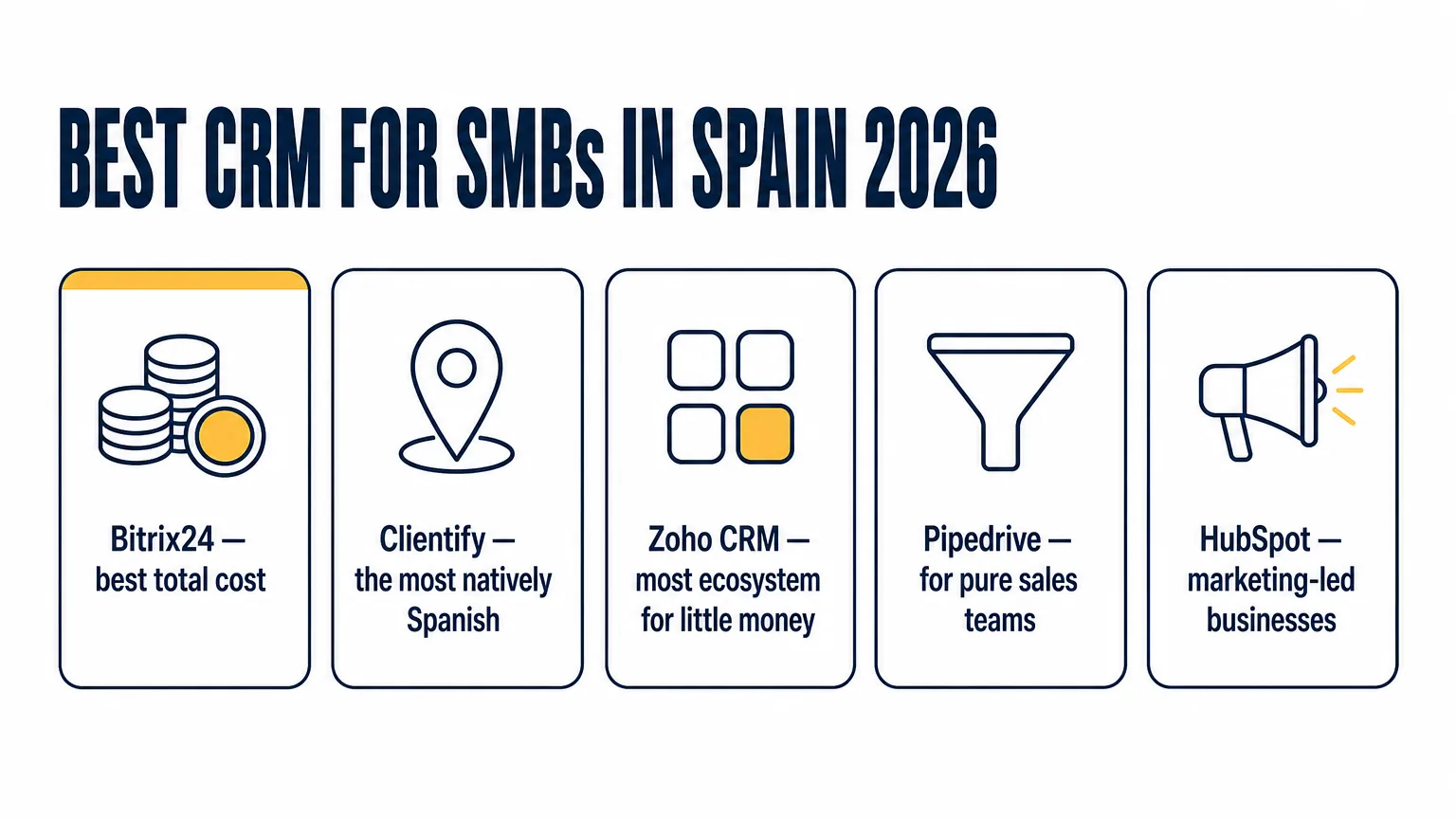
Which CRM is best for an SMB in Spain, at a glance?
- Bitrix24 — TCO and all-in-one for a growing SMB (10–200). Free for up to 2 users; paid from €49/mo per organization
- Clientify — The most natively Spanish CRM (WhatsApp + invoicing + Kit Digital). From ~€39/mo
- Zoho CRM — The most complete ecosystem for little money. From $14/user/mo
- Pipedrive — Pure sales teams that want a clean pipeline. From €14/user/mo
- HubSpot — Marketing-led businesses (starts free). Free plan; paid scales fast
- monday CRM — Visual teams juggling projects and sales. From €12/user/mo (min. 3)
Prices from each vendor's official pages with annual billing, verified in September 2026 (links under “Sources”). Bitrix24, Clientify, Pipedrive and monday publish European pricing in euros; Zoho and HubSpot, in US dollars.
1. Bitrix24 — the best total cost for a growing SMB
Bitrix24 isn't just a CRM: it's a full workspace with CRM, projects, telephony, internal chat and a website builder. That breadth is its strength and its risk: it overwhelms a team that only wants contacts, but it saves five separate subscriptions for an SMB that also organizes internal work. Its decisive difference for Spain is the pricing model: it charges a flat fee per organization, not per user. On small teams you barely notice, but as you grow to 20, 30 or 50 people the gap with any per-user rival explodes — you stay on the same plan while the others multiply the bill with every new hire. For WhatsApp it uses native open channels: the message lands in a shared inbox and creates or updates the contact and deal by itself.
Pros:
- Flat rate per organization: wins on TCO as the team grows.
- WhatsApp, telephony and projects in one panel; a self-hosted (on-premise) option for data control.
- Prices in euros and a Spanish interface (support in Spanish with a local partner).
Cons:
- Steeper learning curve: you configure it, you don't just switch it on.
- Not a VeriFactu-certified invoicing tool; it integrates with your invoicing software.
- The temptation to turn on every module at once.
Price (European storefront, annual billing): the free plan covers up to 2 users; Basic €49/mo (up to 5 users), Standard €99/mo (up to 50 users). Billed per organization, not per user.
For whom: the 10-to-200-person SMB that will grow and wants one platform for CRM, communication and internal work. It's also where we add the most as Bitrix24 implementers.
2. Clientify — the most natively Spanish CRM
Here we do something unusual for a guide signed by a Bitrix24 partner: we place a competitor ahead of almost everyone. Clientify is a Spanish CRM (founded in Almería in 2014), built from day one around how a Spanish-speaking SMB sells: it combines CRM, marketing, multi-user WhatsApp, landing pages and invoicing in a single tool, and in real Spanish — not translated. On the more "Spanish" criteria in this list it scores very high — native WhatsApp, electronic invoicing the company itself presents as VeriFactu-ready, and a historically active position in Kit Digital (it applied as a digitalization agent in "customer management"). If you want one Spanish tool that does almost everything without integrating anything, it's the natural candidate.
Pros:
- Natively Spanish: interface, support and product philosophy built for Spain and Latin America.
- Multi-user WhatsApp and invoicing built in.
- Strong historical presence in Kit Digital (always verify the current call).
Cons:
- More marketing-and-sales than complex operations; plans cap users and contacts per tier.
- Less depth than Zoho or Bitrix24 when the internal process gets complicated.
- Smaller integration ecosystem than the global players.
Price: from €39 per seat per month on annual billing (€65 monthly); seats are added by counter and the marketing-contact limit depends on the plan. Check the official pricing.
For whom: the freelancer or micro-business that lives in WhatsApp, bills in Spain and wants a single Spanish tool without building integrations.
3. Zoho CRM — the most complete ecosystem for little money
Zoho CRM pairs a cheap entry with a depth that surprises. Its strength is the ecosystem — over fifty apps (Books for invoicing, Desk for support, Campaigns for marketing) that fit together — and that's also its risk: ending up with a "zoo" of subscriptions and the classic confusion between Zoho CRM, CRM Plus and Zoho One. Two nuances for Spain: WhatsApp is well integrated, but the full in-CRM experience arrives on the higher plans (Enterprise and up); and invoicing lives in another product of the ecosystem (Zoho Books/Invoice, with a Spanish presence), so confirm its VeriFactu compliance before deciding on that basis.
Pros:
- Very competitive entry price and strong features-per-euro.
- A huge ecosystem if you'll need support, marketing or invoicing from the same house.
- Automation and the Zia AI assistant: some capabilities from the mid plans, the full set on Enterprise and above.
Cons:
- Per-user pricing: it gets more expensive as the team grows.
- The most complete WhatsApp integration sits on the higher tiers.
- The ecosystem can turn into complexity if you don't govern it.
Price (official US-dollar price list, annual billing): Standard $14, Professional $23, Enterprise $40 per user per month; the free edition covers up to three users. We break down the deeper differences in Bitrix24 vs Zoho.
For whom: the SMB that wants to start cheap with room to grow in features, and values having support, marketing and invoicing under one roof.
4. Pipedrive — for pure sales teams
Pipedrive is the most sales-focused CRM on this list: salespeople designed it for salespeople. Its visual pipeline is one of the clearest around and it starts in a day. The catch for a Spanish SMB is that anything beyond pure selling — advanced WhatsApp, lead generation, campaigns — arrives via add-ons priced separately and on the whole company, and that's where the silent bill grows. There's no free plan, only a trial.
Pros:
- The clearest, most intuitive sales pipeline in the comparison.
- Fast start: a sales team gets it in a day.
- Spanish interface and euro billing.
Cons:
- Narrow focus: outside selling, you depend on paid add-ons.
- No permanent free plan.
- WhatsApp and invoicing aren't native; you solve them with integrations.
Price (European storefront, annual billing): Lite €14, Growth €39, Premium €59 per user per month.
For whom: the 3-to-15-person sales team focused on closing, that wants a sales CRM rather than a full workspace.
5. HubSpot — for businesses that lead with marketing
HubSpot is a polished platform, with the gentlest learning curve on the market and a genuinely useful free plan to start. It shines when marketing is the engine: inbound, email, landing pages and deep automation that can trigger on any CRM object. For a price-sensitive SMB, the tricky point is the jump from the entry plans to Professional — a price cliff — and its per-user model; on top of that, its orientation is more Anglo (US, UK). That's why we treat it qualitatively here: the exact figures and the total-cost math we break down in our dedicated comparison.
Pros:
- A powerful free plan to start from zero.
- The simplest usage experience and onboarding on the list.
- Top-tier marketing automation.
Cons:
- A sharp price jump at Professional; per-user model.
- More US-centric market and integration orientation.
- For operations-focused SMBs (not marketing), you pay for what you don't use.
Price: free plan; paid tiers scale per user and the jump to Professional is notable. We compare total cost and model in Bitrix24 vs HubSpot.
For whom: the marketing-led business that wants to start free and for which inbound acquisition is priority number one.
6. monday CRM — for visual, multi-project teams
monday CRM starts from a very visual "work operating system": colorful boards, flexible views and simple automations. It fits teams that handle sales and projects at once and value seeing the status of everything at a glance; it's pleasant to use and easy to customize. Its limits for Spain: it's paid from the start (minimum three users, no permanent free plan), pricing is per user, and neither WhatsApp nor invoicing is native the way a Spain-built CRM would be. It's more a flexible canvas than a Spain specialist.
Pros:
- Visual, highly customizable interface; blends sales and projects well.
- Automations that are simple to set up without a technician.
- Prices in euros, adjusted to your billing country.
Cons:
- No permanent free plan; minimum three users.
- Per-user pricing; WhatsApp and invoicing depend on integrations.
- Less of a "Spain specialist" than Clientify or Bitrix24.
Price: from €12/user/mo (Basic, annual, minimum 3 users); Pro €28/user/mo — official pricing.
For whom: the team that already works very visually, mixes sales with projects, and wants one canvas for everything.
How do you choose by profile?
Don't choose by the overall score — choose by what your business is today.
- Freelancer or micro-business (1–5), the whole relationship over WhatsApp. You want a Spanish tool that integrates WhatsApp and invoicing with nothing to build: Clientify fits naturally. If budget rules, the free plans of Bitrix24 (up to 2 users) or Zoho (up to 3 users) let you start for nothing.
- SMB of 10–30, first CRM out of Excel. You want order without over-engineering: Zoho CRM for its features-per-euro, or Bitrix24 if you also need telephony, projects and internal communication in the same place.
- SMB of 30–200, growing. The pricing model decides the bill: Bitrix24's flat rate wins on total cost against any per-user rival, and the all-in-one avoids the subscription zoo. This is its terrain.
- Pure sales team (selling is 90%). Pipedrive for pipeline clarity, or Zoho if you want room to add marketing and support later.
- Marketing-led business. HubSpot to start free and scale inbound; check the cost before jumping to Professional.
If you're torn between two, the useful question isn't "which has more features?" but "where do I talk to my customers, and how many employees will I be in two years?" With those two answers, the list narrows itself. We go deeper into the method in how to choose a CRM for SMBs.
Kit Digital and your CRM: what's left in 2026?
Kit Digital funded CRM implementation within the "customer management" (Gestión de clientes) category, with €2,000 for one user in companies under 10 employees and €4,000 for three users in companies of 10–49 employees (€10,000 and €14,000 for the 50–99 and 100–249 segments). The uncomfortable part: the main calls closed at the end of 2025, and in 2026 the official acelerapyme.gob.es site states that the program's calls have ended, though there have been extension phases over remaining funds.
Translated into a decision: don't count on Kit Digital as guaranteed money, but don't rule it out without looking either. Check the current calls and the status of the funds on the official site before choosing on that basis. And beware a common idea: we are not accredited digitalization agents; we help you implement the CRM well, not process the grant. If the aid is your deciding factor, prioritize a provider that does appear as a current digitalization agent.
VeriFactu: what does it mean for your CRM?
There's a lot of noise here, so let's stick to the facts. VeriFactu is the Anti-Fraud Law system that requires invoicing software to meet certain traceability and integrity rules. The date matters: with Royal Decree-law 15/2025, the obligation moved to 2027 — from 1 January 2027 for companies (corporate tax) and from 1 July 2027 for the self-employed. You can verify it at the Tax Agency's site.
Two clarifications that avoid costly mistakes:
- VeriFactu regulates your invoicing software, not your CRM. A CRM doesn't "comply with VeriFactu" by itself; what matters is that it plays well with the invoicing tool that does have to comply.
- Don't confuse it with the mandatory B2B electronic invoicing (Ley Crea y Crece), which is a separate rule with its own timetable and still pending regulation.
So 2026 is a preparation year. If you're choosing a CRM now, check how it connects to your invoicing: Clientify integrates invoicing natively and presents it as VeriFactu-ready; Zoho covers invoicing with Zoho Books/Invoice (confirm its compliance); Bitrix24 and the rest rely on integrating with your certified invoicing software. No option leaves you stranded if you plan ahead.
What do we recommend?
If we had to sum it up for the typical Spanish SMB in this guide — 10 to 200 people, living in WhatsApp and billing in euros — Bitrix24 is in most cases the most rational choice for total cost and for bringing CRM, communication and internal work into one place. We say it as its partner, and precisely for that reason we add this caveat: if you're a freelancer or micro-business and want a 100% Spanish tool with WhatsApp and invoicing built in, Clientify will probably serve you better; and if your business revolves around marketing, look at HubSpot first.
The right answer depends on your processes, not on a score. At Auspex we help SMBs in Spain choose the right CRM for their real tasks and implement it without the usual migration mistakes, from our office in the Canary Islands. If you're deciding, book a free consultation and we'll assess your case: which tool fits, what your total cost will be, and how to move from WhatsApp and Excel to a CRM you'll actually use. You can also see how we work in CRM implementation.
Sources
- Bitrix24 — official pricing (European storefront, euros)
- Clientify — official pricing (in Spanish)
- Zoho CRM — official pricing
- Pipedrive — official pricing (European storefront)
- monday CRM — official pricing
- Kit Digital — "Gestión de clientes" category, grant amounts by segment (acelerapyme.gob.es)
- Agencia Tributaria — VeriFactu deadline extension (Real Decreto-ley 15/2025)