
You've more or less chosen your CRM. The next decision — who sets it up — is what decides whether it works. Get it wrong and you own an expensive contact list nobody opens; get it right and the tool quietly earns its keep for years.
One disclosure up front, because it shapes everything below: we are an implementation partner ourselves. Auspex is a Bitrix24 Gold Partner in EU markets, a brand implementing CRM since 2015, with offices in Spain and Ukraine (for the Ukrainian market we implement Uspacy). So read this like advice from anyone who profits when you hire a partner — with healthy suspicion. That's exactly why it's built as questions you can turn on us.
Freelancer, agency or vendor services: which should you pick?
The first decision isn't which partner but what kind. Three formats exist, and the right one depends on how complex your setup is and how much you can manage yourself.
- Freelancer / independent consultant — Simple setup, one platform, tight budget, you can manage them. Cheap, fast, direct access to the person doing the work. Bus factor (one person, one holiday); narrow skills; may disappear after launch. Hourly / day rate; lowest sticker
- Boutique agency / implementation partner — You need process design, integrations, training, and accountability after go-live. A team with complementary skills, a methodology, references, continuity, certifications. Variable quality; you may get juniors; higher cost; some are resellers in disguise. Fixed scope or retainer; mid
- Vendor's professional services — Large or complex project; you want the platform maker's own people. Deepest product knowledge, direct escalation to the source. Expensive; product-first, not process-first; built for enterprise, not a 10-person team. Highest; often a mandatory onboarding fee
A freelancer fits a genuinely small job with someone on your side to steer; the trade-off is fragility — one person is one point of failure, with no bench when a migration turns out harder than expected. A boutique agency or implementation partner is what most growing SMBs actually need: not just configuration, but process design, migration, integrations, training, and someone still there when a problem surfaces weeks after go-live. Quality varies, though — a good partner sends seniors who ask hard questions, a weak one a junior with a template — which is exactly what the 12 questions below test. Vendor professional services, the CRM maker's own team, suit large or complex rollouts; for a 10-to-200-person business they're overkill: expensive, product-first, enterprise-priced.
License seller or process implementer: which one are you hiring?
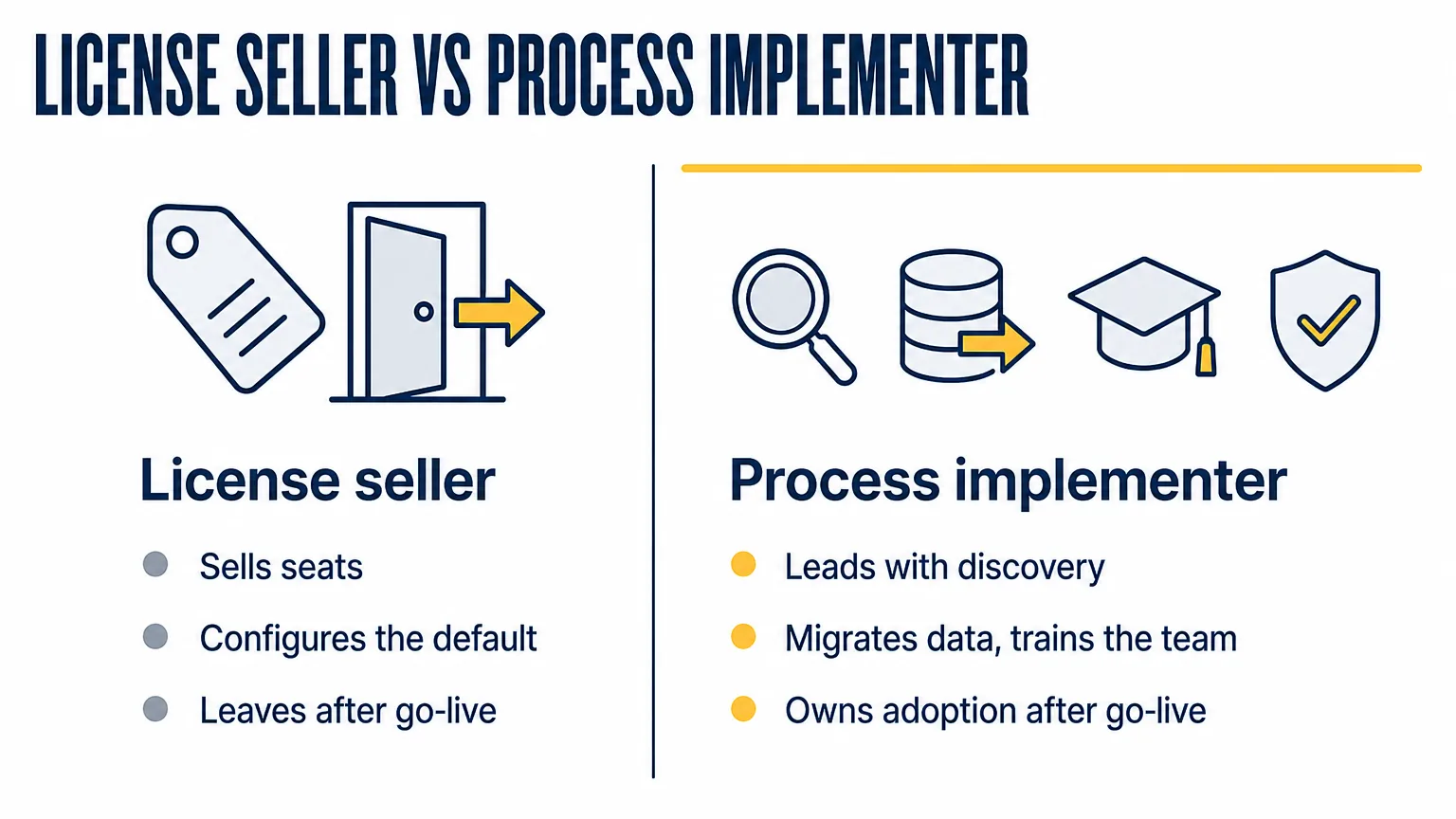
The same words — "CRM partner" — hide two different businesses, and spotting which is which on the first call saves months. A license seller makes money on the subscription: they talk platform — features, seats, tiers — and reach a quote fast, opening with "how many users?" Nothing wrong with that; resellers are normal. But their incentive ends the moment you sign, because their margin is the license, not whether your team adopts it. A process implementer makes money — and reputation — on your adoption: they ask about you first — how leads arrive, where deals stall, who does what, what breaks today, what "success" would even mean — and price only after they understand the scope. The tell is simple: in the first twenty minutes, did they spend more time on their product or your problem? Both can deliver a working CRM, but you brief, price, and hold each accountable completely differently, so you need to know which one you're hiring.
Which pricing models exist, and who owns adoption?
Implementation is priced one of two ways, and each fails predictably. Fixed-price suits well-scoped, standard setups and gives budget certainty; the risk is a padded estimate, or corners cut to protect margin when reality diverges — every change becoming a friction-filled change order. Time and materials (T&M / day rate) suits discovery-heavy work and integrations with unknowns; the risk is an open-ended bill, so it needs a partner you trust and a cap agreed in writing. The healthiest arrangement is often a hybrid: a small fixed discovery phase, then a phased build.
But the model matters less than the question most buyers forget to ask: who owns adoption after go-live? A CRM that's "configured" but unused is a failed project. Ask explicitly whether training and post-launch support are in scope, or whether the engagement ends at "it's set up." The best partners tie part of the work — a follow-up phase, ongoing support, sometimes payment — to people actually using the system, not just to delivery.
Which 12 questions should you ask before you sign?
Ask every candidate these, us included — and watch how comfortable they are being asked.
- "Walk me through your discovery — what will you ask us before proposing anything?" Someone who can't describe discovery will skip it, and the CRM ends up mirroring their assumptions, not your business.
- "Can you show a case in our industry or a similar-size company, with a reference I can call?" Callable references beat a wall of logos, and sector experience saves weeks.
- "Who exactly does the work — the person on this call, or someone else?" Guards against the bait-and-switch where a senior wins the deal and a junior builds it.
- "What's your data-migration plan, and how do you handle duplicates and bad records?" Migration is where projects quietly break; a vague answer here is a loud warning.
- "How will you train our team, and what materials do we keep?" No training plan means no adoption — and knowledge that lives only in their head means dependence forever.
- "What happens after go-live — what support is included, and for how long?" Separates a partner who delivers an outcome from one who delivers a configuration and vanishes.
- "Is the price fixed or time-and-materials, and what triggers a change order?" Surfaces the hidden cost of scope changes before it hits an invoice.
- "What do you need from us, and how many hours of our team's time?" A partner who means it admits implementation is two-sided; "just leave it to us" signals inexperience or a coming disappointment.
- "Which parts of our request would you push back on, or say we don't need?" A partner who agrees to everything is billing you, not advising you.
- "How do you measure whether the implementation succeeded?" Forces a definition of "done" beyond "it's configured."
- "If we leave, do we own the configuration and our data?" Avoids a quieter lock-in — to the partner, not just the vendor.
- "Are you a certified partner of this platform, and do you also resell the license?" Reveals both competence and where their margin comes from; reselling isn't disqualifying, but you should know.
What are the red flags?
A few signals should make you slow down. None is fatal alone; stacked together, they're a pattern.
- No discovery — straight to a quote. They're selling a template, not solving your problem. Real setup starts with understanding, not pricing.
- "Live in three days." Basic setup, maybe; a CRM tuned to your process and your team's habits takes weeks, and that speed means corners cut somewhere you'll find later.
- They never ask about your processes. If nobody wants to know how you actually sell and where deals stick, the result reflects their assumptions, not your business.
- No training or change-management plan. The hard part of CRM is getting people to use it; ignore adoption and you're handed a shelf, not a system.
- "The CRM will solve everything." It's a tool — it won't fix an undefined sales process or make anyone enter data they don't want to. That's overselling.
- Evasive on price, scope, or references. If "who does the work, what's the pricing model, can I call a client" gets no straight answer, the evasiveness is the answer.
What does a healthy implementation look like?
For a 10-to-200-person business, a sound implementation runs through four phases — two to four weeks for a base go-live, up to six with integrations, with a median around 30 days; not days, and rarely many months for a team that size.
- Discovery (a few days to ~2 weeks). The partner maps your sales process, data, and the tools to connect, and defines success. The deliverable is a scoped plan and a price you can trust, because it's based on your reality, not a guess.
- Pilot / core setup (1–3 weeks). They configure the CRM core — pipeline, fields, roles, permissions — for one team or process and test it on real data. Starting narrow beats switching on every module at once, the classic SMB mistake.
- Rollout (1–2 weeks). Data migrated, integrations connected, the setup expanded to the full team, and cutover from your old spreadsheet or messy older CRM.
- Adoption (ongoing; first ~4–8 weeks critical). Training, hand-holding, removing friction, watching whether people actually use it. This is where value is won or lost — and where cheap engagements end just before the payoff.
Anyone quoting days is describing setup, not implementation; anyone quoting many months for a ten-person team may be over-engineering it.
When don't you need a partner?
Here's what most agency guides omit: sometimes the right answer is to hire no one. If your team is small (under five to ten people), your sales process is standard — leads come in, someone calls them, deals move through a simple pipeline — and your CRM has strong self-serve onboarding, you can very likely implement it yourself. Modern SMB CRMs are built for exactly this: guided setup, templates, importers, and decent documentation. Spend a focused weekend on the vendor's onboarding, import your contacts, build one pipeline, and start — you'll learn the tool better by doing it, and you'll keep the money.
Bring in a partner when it gets harder: multiple integrations, migration out of a messy old system, genuinely custom processes, a change-resistant team, or simply no internal hours to spare. Don't pay for help you don't need — but don't underestimate adoption: the software is the easy part, and getting people to change how they work is where a good partner earns the fee. Unsure which camp you're in? Our guide on how to choose a CRM for an SMB is a useful first read.
What does a CRM implementation partner cost?
Implementation cost varies enormously with complexity, so a firm number before anyone understands your business is a guess. A few anchors help you sanity-check a proposal; all figures below are in euros.
Start with a revealing fact: even CRM vendors charge for implementation. HubSpot applies a mandatory onboarding fee on its Professional tiers — $1,500 for Sales Hub Professional (≈€1,320 at the ECB reference rate of 1 USD = 0.88 EUR, July 2026), rising for larger Marketing or Enterprise setups — see HubSpot's pricing. If the software's own maker prices setup separately, "just buy the license" was never the full cost.
For partner-led work, treat these as directional market ranges, not an Auspex quote:
- A freelancer, simple single-platform setup: from a few hundred euros for the first workflow, depending heavily on region and scope.
- A boutique partner, scoped SMB implementation: typically in the low thousands of euros, more with heavy data migration or several integrations.
- Vendor professional services or genuinely complex projects: several thousand euros and up.
- Ongoing: budget for support and optimization after launch — a line of its own, not the leftover from implementation.
Two caveats: these are rough public-data ranges, not a promise from us — real cost depends on your process complexity, data volume, integrations, and training needs. And get a scoped estimate after discovery, never a firm number by phone; quoting before understanding your business means padding for the unknown, or change orders later.
What do we recommend?
The best CRM implementation partner isn't the cheapest or the one with the most logos. It's the one who understands your process before quoting, tells you plainly what you don't need, prices transparently, and stays accountable for adoption after go-live. Run every candidate — us included — through the 12 questions and the red flags. If a partner gets uncomfortable when you ask who owns adoption or whether you can leave with your data, you've already learned what you needed.
So you can apply the same test to us: Auspex is a Bitrix24 Gold Partner in EU markets (you can check our partner credentials), operating since 2015 with offices in Spain and Ukraine; for the Ukrainian market we implement Uspacy. And yes, please hold us to this same checklist. For a scoped conversation rather than a sales pitch, start with a free CRM audit.