
Choosing a CRM in Ukraine in 2026 is not an ordinary feature comparison — it happens on a market that went through a forced migration. Until 2023, a large share of Ukrainian companies ran on Bitrix24 and amoCRM, both of Russian origin. On 15 April 2023, Ukraine's President enacted National Security Council sanctions against Bitrix24 (decree No. 227/2023, sanctions for ten years — until 2033), and from 1 June 2023 its cloud portals became inaccessible to Ukrainian users, with data deleted. Cloud operator GigaCloud estimated that 80,000+ users across more than 10,000 Ukrainian companies had to migrate. So the first rule of choosing in 2026 is simple: Bitrix24 and amoCRM are no longer candidates.
A word on who's writing this. Auspex has implemented CRM since 2015 and is a Bitrix24 Gold Partner in EU markets. For the Ukrainian market we deliberately implement on Uspacy — backed by a live case, the migration of recruiting company UpdateActive. We also implement monday.com, Pipedrive and Zoho; the view on HubSpot, KeyCRM, NetHunt and SalesDrive in this guide is analytical, based on official vendor data. No vendor pays us for placement in this ranking.
How do you compare CRMs in Ukraine in 2026?
Most systems share the basics — pipelines, records, tasks. The differences that actually cost money and nerves come down to five criteria specific to the Ukrainian market.
- Ukrainian localization and support. Interface, docs, and support in Ukrainian, in your time zone. Global platforms vary here: Zoho CRM, for example, is only partially localized into Ukrainian (customizable elements are translated, while Russian is fully supported), and HubSpot has no Ukrainian locale at all (Pipedrive does).
- Local integrations. What decides deals in Ukrainian e-commerce and services: Nova Poshta and Ukrposhta shipping, marketplaces (Rozetka, Prom, OLX, Allo), fiscalization via software RRO (Checkbox, Vchasno.Kasa), acquiring (monobank, LiqPay, WayForPay, Privat24), and telephony (Binotel, UniTalk, Ringostat). A ready "create a waybill" button saves hours a day; its absence means custom development.
- Data and continuity. Where your data physically lives, how much you control it, and how the system behaves during blackouts. A mobile app that runs from a phone on backup power is a wartime requirement, not a nice-to-have.
- Pricing currency versus hryvnia revenue. Subscriptions in dollars or euros against hryvnia revenue put FX risk into your P&L. Hryvnia billing — or at least a fixed rate — matters.
- Depth of CRM features. Pipelines, automation, reporting, access control, customization, and AI assistants. Ukrainian products are younger than the global ones — it pays to understand precisely what you give up, if anything.
Which CRMs are best for a Ukrainian business? A quick comparison
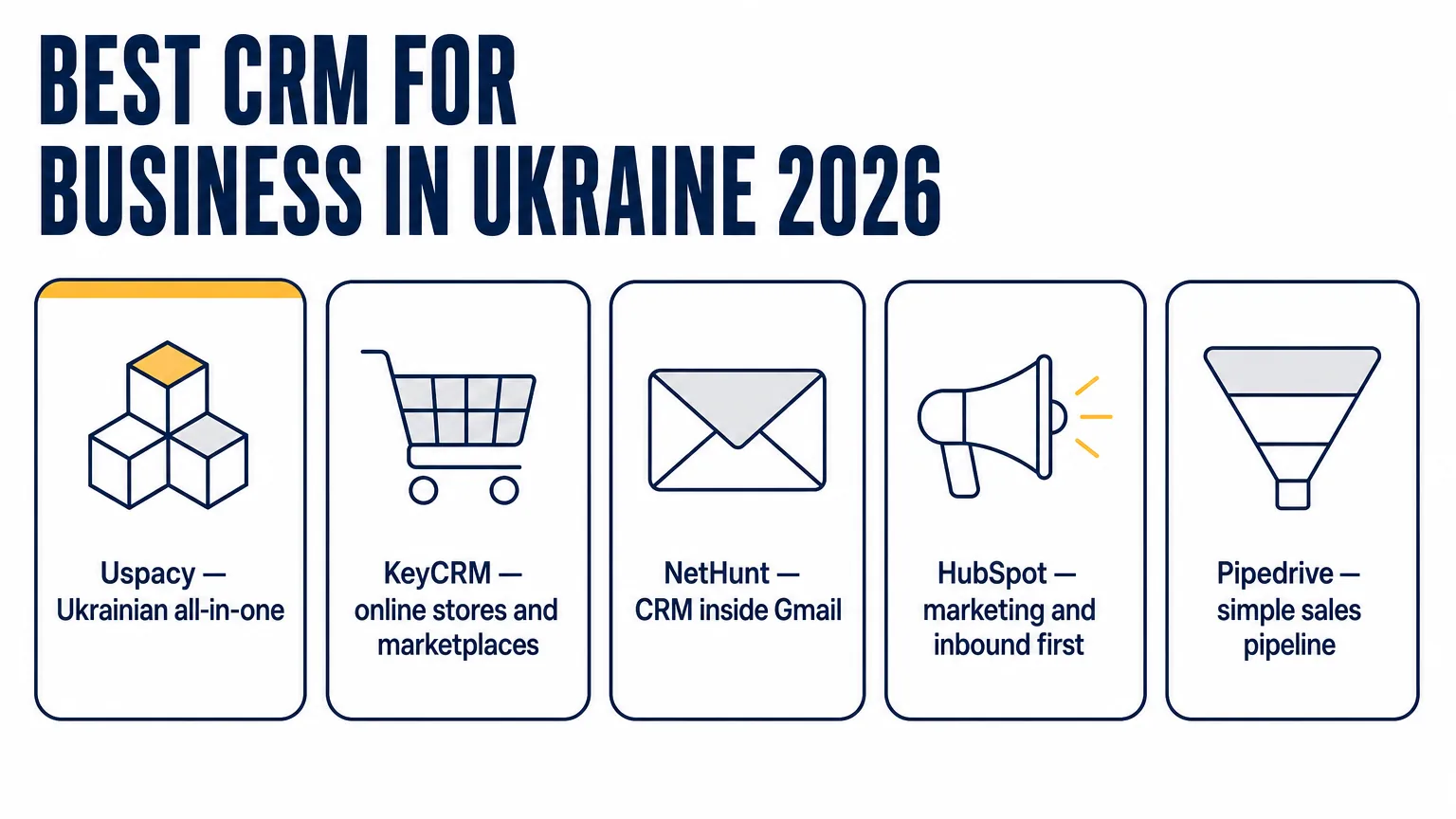
- Uspacy — Services, B2B, all-in-one. Ukraine. Nova Poshta, Rozetka/Prom, Checkbox, telephony. ₴408 per user (₴327 with the Ukraine discount)
- KeyCRM — Online stores, marketplaces. Ukraine. Nova Poshta, Rozetka/Prom/OLX, RRO. ≈€17 per org: by volume, unlimited users
- NetHunt — B2B sales inside Gmail. Ukraine. Nova Poshta, Prom/OLX, telephony. €8 per user
- HubSpot — Marketing and inbound. USA. None (only via Zapier/Make). ≈€17.5 per seat
- Pipedrive — Simple sales pipeline. Estonia/USA. None (only via Zapier/Make). €14 per seat (Lite)
- Zoho CRM — Need for an app ecosystem. India. None native; partial Ukrainian locale. $14 per user
¹ Prices are for annual billing, as of September 2026; links to vendor price lists are in Sources. Uspacy publishes in hryvnia, Pipedrive and NetHunt on the European storefront in euros, Zoho and HubSpot in US dollars. Where a euro equivalent of a dollar amount is shown for comparison, it uses the ECB rate of 1 USD = €0.88 (July 2026); the vendor's own euro price may differ.
Uspacy — Ukrainian all-in-one and our working choice for the market
Uspacy is a Ukrainian product that combines CRM, tasks, and internal communication in one workspace. The vendor positions it explicitly as an alternative to Bitrix24, Pipedrive, and HubSpot, and it's the platform we at Auspex implement for Ukrainian clients. So let me declare the bias upfront: this section speaks from practice, not just from the website.
Why Uspacy covers most of the criteria above. Interface and support are in Ukrainian. Local integrations live in a built-in app store: Nova Poshta (waybills and status sync from the deal card), marketplaces Rozetka, Prom, Allo, Kasta, fiscalization via Checkbox and Vchasno.Kasa, acquiring via Finline (NBU-authorized) and AssetPayments (Visa/Mastercard/Privat24), UniTalk telephony and more. Monobank payments are built on top of the open API. This "CRM core plus apps" architecture is what keeps the system flexible.
Pros: a Ukrainian product with local integrations out of the box; all-in-one without a zoo of subscriptions; open API; affordable; priced and invoiced in hryvnia. Cons: younger than the global platforms — some advanced automation and analytics scenarios have to be assembled from apps; the library of ready connectors is narrower than HubSpot's or Zoho's. Price (as the vendor publishes it): a free tier for up to five users; Standard ₴408 per user per month on annual billing, ₴327 with the 20% Ukraine discount; Professional ₴817 (₴653 discounted). Who it's for: services and B2B companies, distributors, agencies — anyone who needs a Ukrainian workspace, not just deal cards. If you're weighing Uspacy against monday.com, see our separate monday vs Uspacy comparison.
KeyCRM — for online stores and marketplaces
KeyCRM is a Ukrainian CRM (on the market since 2019) focused on product businesses: orders from every marketplace in one window. If you sell on Rozetka, Prom, OLX, Allo, Etsy, eBay, or Amazon alongside your own Shopify or WooCommerce store, KeyCRM pulls it all into one panel. Built-in shipping integrations (Nova Poshta, UPS, DHL) give one-click waybills and automatic tracking, while software RRO covers fiscalization.
The pricing is unusual and worth explaining. Instead of per-user tiers, KeyCRM charges by volume: a base plan of ≈ €17 per month includes 200 orders, 2,000 leads, and 20,000 chat messages, the full feature set, and unlimited users. Connecting synced sources costs another ≈ €17 per month for an unlimited number of platforms. Overages are bought in blocks of about €8 (200 orders, 2,000 cards, or 20,000 messages). It's a pay-after model: you're billed for actual usage.
Pros: marketplaces and shipping out of the box; unlimited users; self-setup in 1–2 days without an integrator; RRO, inventory, POS. Cons: cost grows with volume, not headcount — seasonal peaks add up; it's primarily a trading CRM, a weaker fit for classic B2B services. Price: base plan ≈ €17/month per organization plus ≈ €17 for source connections; then by volume.² Who it's for: online stores and product businesses of any size with a high order flow across several channels.
NetHunt — a CRM inside Gmail for B2B teams
NetHunt is a Ukrainian company from Kyiv (founded in 2015, a Lviv IT Cluster member, backed by the Google for Startups Ukraine Support Fund). Its core idea is to turn Gmail into a full CRM: customer records, deals, and automations live right in the inbox and Google Workspace. It's a solution for B2B sales, especially teams doing outbound and working heavily in Gmail and professional networks.
For the Ukrainian market NetHunt has a real advantage — an official price list in euros, so there's no FX surprise (invoices are issued in the hryvnia equivalent at the PrivatBank rate). There are integrations with Nova Poshta, the Prom and OLX marketplaces, telephony, messengers (Instagram, Viber, WhatsApp, Telegram), and record enrichment from state registries. Ukrainian non-profits get a dedicated support program.
Pros: native work inside Gmail/Google Workspace; strong outbound and LinkedIn; official euro pricing; flexible custom pipelines and fields. Cons: value is realized mostly inside the Google ecosystem; RRO fiscalization isn't a core focus; per-user pricing adds up on larger teams. Price: Basic €8, Basic Plus €12, Business €20, Business Plus €28 per user per month on annual billing (official euro pricing). Who it's for: B2B teams living in Gmail and doing active sales, rather than processing marketplace order flow.
HubSpot — when marketing and inbound come first
HubSpot is a global platform that grew from a marketing suite and is built around a single contact database. Its strengths are a fast start, an intuitive interface, deep automation across any objects, and powerful marketing tools: landing pages, email campaigns, inbound analytics. For a Ukrainian business it's a fit for a specific job rather than a universal choice.
The weak spots for our market are known. There's no Ukrainian localization and no native local integrations — Nova Poshta, RRO, or monobank have to go through Zapier/Make or custom development. The per-seat model multiplies the bill as you grow: what looks free at the start becomes a real line item on a team of 20–50.
Pros: best-in-class marketing and inbound; fast implementation; a free starter tier; a huge library of ready connectors (mostly for the US market). Cons: no Ukrainian locale or local integrations; per-seat pricing scales expensively; onboarding is paid on higher tiers. Price: Sales Hub Starter ≈ €17.5 per seat per month on annual billing; Professional $90 per seat per month (annual billing) plus a mandatory one-time onboarding fee of $1,500 (≈€1,320 at the ECB rate of 0.88, July 2026). Who it's for: marketing- and inbound-led companies for which speed and automation depth outweigh local integrations and price.
Pipedrive — a simple sales pipeline
Pipedrive is a lightweight, sales-focused CRM with a visual pipeline and a low barrier to entry. It does one thing well: moving a deal through stages without overloading the rep. It's a solid pick for a small sales team that doesn't want to learn a combine harvester.
The limitations mirror HubSpot's, with a sales twist. Pipedrive does have a Ukrainian interface locale, but there are no native Nova Poshta or RRO integrations — everything runs through Zapier/Make. There's no free tier (only a 14-day trial), and some capabilities (lead generation, campaigns) are separated into paid add-ons billed per company, so the final bill can exceed expectations.
Pros: simple and fast to set up; a clear pipeline; predictable logic for a sales team; a Ukrainian interface locale. Cons: no native local integrations; no free tier; add-ons cost extra; narrow beyond sales. Price (European storefront, annual billing): Lite €14, Growth €39, Premium €59 per seat per month. Who it's for: small sales teams that need a clean pipeline without local specifics.
Zoho CRM — when you need a whole ecosystem
Zoho CRM is part of an ecosystem of 55+ apps (mail, accounting, support, campaigns). If you want your entire back office under one vendor, that's a strong argument, and the CRM itself is mature and deeply customizable, with the Zia AI assistant, whose full set of capabilities unlocks on the higher tiers.
Two caveats for the Ukrainian market. First, localization: the interface is only partially translated into Ukrainian (Russian is fully supported), which is daily friction for a team that works in the state language on principle. Second, there are no native integrations with Nova Poshta, RRO, or monobank — they're built via Zapier, Make, or the API. Add the "subscription zoo" risk: telling where CRM ends and CRM Plus or Zoho One begins isn't obvious the first time.
Pros: a mature CRM in a large ecosystem; deep customization; a strong price-to-feature balance. Cons: partial Ukrainian locale; no native local integrations; complexity of picking the right edition in the ecosystem. Price (official US-dollar price list, annual billing): Standard $14, Professional $23, Enterprise $40 per user per month; the free edition covers up to three users. Who it's for: companies that need a cohesive set of business apps from one supplier more than a CRM, and for which Ukrainian localization isn't critical.
What about SalesDrive? Another Ukrainian CRM (on the market since 2012) worth keeping in view for product and automotive businesses. Its strengths are a traditional pipeline, deep integration with Nova Poshta, Ukrposhta, Rozetka Delivery, and Meest, built-in telephony (a virtual PBX), receipts, and RRO. In spirit it's closer to KeyCRM but with an emphasis on calls and the classic sales process. We don't implement SalesDrive, so we cite it as a reference point rather than a hands-on recommendation; check current pricing on the vendor's site.
How do you choose by business profile?
- Online store, marketplace sales → KeyCRM (all channels and shipping in one window) or SalesDrive if calls and a traditional pipeline are critical.
- Services, B2B, distribution, agency → Uspacy: a Ukrainian all-in-one with local integrations and hryvnia billing.
- A small team living in Gmail and doing active outbound → NetHunt.
- A business where marketing and inbound come first → HubSpot, if you accept the price and connecting local services separately.
- A small sales team that needs a clean pipeline → Pipedrive.
- A cohesive app suite from one vendor, Ukrainian locale not critical → Zoho CRM.
If the question is broader than "which CRM" and starts with "is it even time to leave spreadsheets," begin with CRM vs Excel, then walk through our guide to choosing a CRM for SMB.
Migrating from an old CRM: what do you move and where do teams slip?
Most Ukrainian companies are now choosing not their first CRM but their second — after a forced move. A few practical pointers from our implementations.
What to migrate: contacts and companies, open deals and leads, communication history, pipeline configuration, and custom fields. Closed deals older than 2–3 years are often smarter to keep in an archive export than to drag into the new system.
Common mistakes: migrating the base "as is," dupes and junk included (clean it first); turning on every module at once instead of starting with the CRM core; underestimating team training; not budgeting time for adoption after go-live — which is where most implementations die. For EU markets we compared the available alternatives separately in Bitrix24 vs Zoho; for Ukraine the logic differs, which is exactly why we implement on Uspacy.
What's the verdict?
The market here matters more than any ranking. But to boil it down to one sentence: for a typical Ukrainian SMB in services and B2B we consider Uspacy the most rational start — a Ukrainian product with local integrations, continuity, and hryvnia billing, and the one Auspex implements for the Ukrainian market (which we say openly). For online stores KeyCRM makes more sense, for Gmail-centric teams NetHunt, and the global platforms are justified where their strength (HubSpot's marketing, Pipedrive's simplicity, Zoho's ecosystem) outweighs the loss of local integrations.
The right answer still depends on your processes, not on a table. Auspex helps Ukrainian companies choose a CRM for their real tasks and implement it without the usual migration mistakes. Start with CRM implementation or book a free audit — we'll assess your specific case.
Sources
- Presidential Decree of Ukraine No. 227/2023 of 15 April 2023 (NSDC sanctions decision), in Ukrainian
- DOU: Bitrix24 leaves Ukraine — scale of the migration (GigaCloud estimate), in Ukrainian
- Uspacy — official pricing (in Ukrainian)
- Pipedrive — official pricing (European storefront, euros)
- Zoho CRM — official pricing
- Zoho CRM — supported interface languages
- HubSpot — official Sales Hub pricing (mandatory one-time onboarding)
- KeyCRM — company story
- NetHunt CRM — about the company
- SalesDrive — about the company (in Ukrainian)
- Cabinet of Ministers Resolution No. 1335 — register of prohibited software (in Ukrainian)