
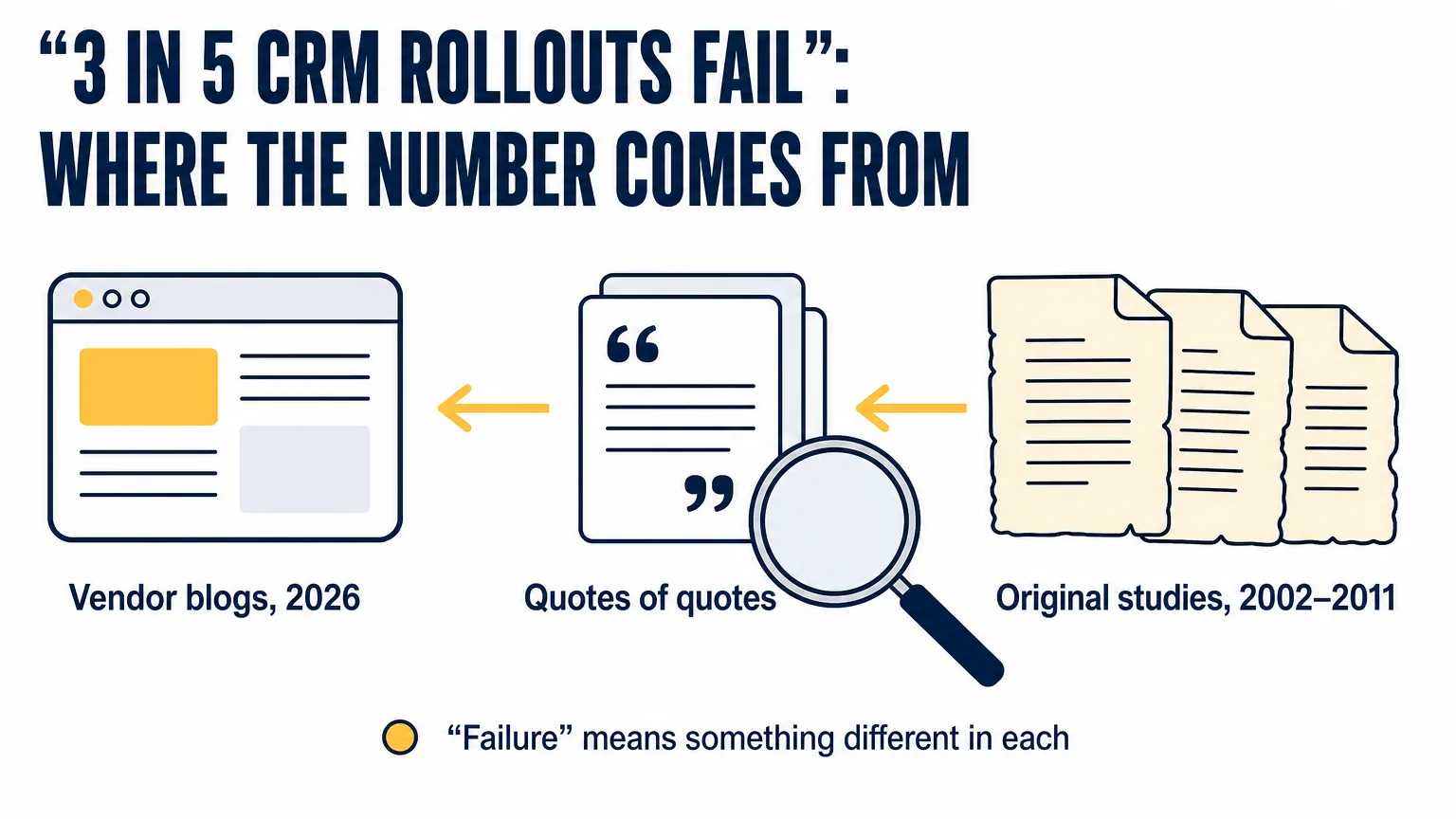
Where did the number come from?
Public figures on CRM failure almost always arrive without a date or a method. Follow the references and the chain turns out to be short and old.
In December 2002, ZDNet pulled the estimates of the day into a single column: a Butler Group report put failed implementations at 70%; a Gartner study found about 55% of CRM projects fell short of customer expectations; and a Bain & Company survey of 451 executives placed CRM among the three worst of 25 popular management tools on satisfaction.
MIT Sloan Management Review, writing in 2011, cites 55–75% of companies that never got the return they expected from CRM. The footnote names the source: a meta-review by Zablah, Bellenger and Johnston (2004), which in turn points to a Gartner Group study — “the most authoritative,” in their phrasing. So this isn't a new measurement. It's a citation of a citation.
Foss, Stone and Ekinci report CSO Insights data in 2008: in an international survey of 1,337 companies that had rolled out CRM to support their sales teams, only 25% reported a significant improvement in results. Next to it sits a Gartner estimate — around 70% of CRM projects ended in losses or added nothing to P&L.
GfK Marketing Intelligence Review repeats the familiar third in 2010: a significant improvement in results for only a third of CRM projects. One detail usually lost in the retelling — the authors give that third with a reference to earlier research, not as a measurement of their own. Their contribution lies elsewhere: they tested how technological and organizational implementation and internal support affect customer acquisition and retention. And they recorded separately what almost nobody mentions: one in five CRM initiatives damaged long-standing customer relationships.
- Butler Group, 2002 — 70% of implementations failed
- Gartner (via ZDNet), 2002 — about 55% of projects fell short of customer expectations
- Zablah et al., 2004, citing Gartner — 55–75% of companies got less than they expected
- CSO Insights (via Foss, Stone, Ekinci), 2008 — significant improvement at 25% of 1,337 companies
- Gartner (via Foss, Stone, Ekinci), 2008 — around 70% of projects with no gain in P&L
- GfK MIR, 2010 — significant improvement in a third of projects; one in five initiatives damaged customer relationships
- CRMGuru.com, Mangen Research Associates, Caribou Lake, 2002 — 35% failures and 45% of projects that paid back
Why does “failure” mean something different in every study?
The numbers don't even add up arithmetically. In the CRMGuru.com study 35% of implementations failed and 45% delivered a return — together that isn't a hundred percent, and the authors have no name for the gap left in between. The reason for the spread is simple: some researchers asked executives whether they were happy with the outcome; others looked at whether the company's financials moved; others counted payback across the whole life of the system. Answers to three different questions aren't obliged to agree.
Many reports define success by management impressions rather than evidence of ROI.
— Adrian Mello, ZDNet, 2002
“Three in five” is 60% — a number that appears in none of the original sources. It's convenient for a headline and safe in an argument: refuting it is as hard as confirming it.
Which study counted differently?
One of those early studies framed the question differently. CRMGuru.com, together with Mangen Research Associates and Caribou Lake Customer-1, judged implementations not by the impression at go-live but by the result across the whole life of the system. Failures came out at 35% — less than half the level the analysts were quoting. Another 45% delivered a return.
The difference isn't a rosier count. It's when you measure. Most of the financial benefit from CRM comes from projects that keep customers and raise what those customers spend, and effects like that rarely show up in under a year or two. A survey run three months after go-live will register disappointment every time, whether or not the system works later.
Which four factors decide CRM ROI?
The same study isolated four implementation factors that determine whether the return arrives:
- A customer-centric strategy — the most important of the four. Companies that come to CRM to placate demanding customers rather than reorganize around them almost never succeed.
- Front-line involvement. You can't force a sales rep to use a tool. You can show them that the system takes work off their plate — forecasts, quotes, manual reports. Which work exactly, you only find out by asking them during design.
- Willingness to change the organization. If every pricing decision still sits at the center, CRM won't speed up deals no matter how much goes into it. Refusing to change roles does more damage than keeping the status quo.
- Measurable goals. Without a metric taken before go-live, there's no way to track either progress or payback.
No single factor is enough on its own. And none of the four is software. The study's authors put it plainly.
The data shows that in the absence of the four key success drivers, any implementation will struggle to achieve positive ROI — regardless of which system is chosen.
— Dick Lee, Caribou Lake, co-author of the study
MIT Sloan Management Review arrives at the same conclusion from another direction. Companies bought call centers, databases, software and websites, then carried on working exactly as before, assuming customers would appreciate the investment itself. A company's ability to deal with customers in a new way doesn't arrive as a side effect of buying a system. It comes first.
What does this mean for a team of 10 to 200?
None of these studies was about small business. They describe corporations with budgets you don't have and problems you don't have either. But the four factors cost nothing, which is why they scale down without loss.
When CRM doesn't work, the cause is usually looked for in two places: the wrong system was picked, or the sales team is sabotaging it. Both versions are convenient because neither touches how the job was framed at the start.
A rep who “doesn't enter anything” is a symptom, not a diagnosis. Nobody fills in a record when they can't see what it changes in their own work. The owner doesn't look at the dashboard when nobody agreed before go-live which number should appear there and what to compare it against. Both decisions get made before anyone opens the system settings for the first time.
What does Auspex do differently?
Auspex is a CRM implementation and business process automation company. Since 2015, across 1,500+ projects for 1,200+ companies, we've boiled the prevention of this failure down to three working rules.
First: we don't roll out “a CRM,” we roll out one process. On one European project, a single contract milestone reads like this: every form on the company's websites creates a lead in the CRM with the source and UTM tag preserved. Not “launch the system,” but one chain you can show in a demo and close with a sign-off. Then you take the next one.
Second: the baseline. If you can't name a number today — how many inquiries get lost, how many hours a rep takes to answer — then six months from now there will be nothing to pay back. Nothing to compare against.
Third, the acceptance criterion. In our SOWs (statements of work), success reads not as “the pipeline is configured” but as “the team works in the CRM.” One word of difference, and it moves the risk of nobody using it from the client to us.
Auspex doesn't publish its own failure rate. For that number to mean anything, we'd have to measure ROI the same way across every client for years after handover. Nobody has that data — not us, and not the studies everyone cites.
What should you ask a vendor before you sign?
- Which single process do we launch first, and what will its demo look like?
- Which number are we measuring, and what is it today?
- What is written as the acceptance criterion: the system is configured, or the team works in it?
- Who owns the system on our side after handover?
- How many weeks until we see the first result, rather than the first screen?
The question “which one process are we measuring and what is its number today” costs less before the contract is signed than after six months of empty dashboards. If your team is deciding right now whether to roll out a CRM, forward this to whoever will answer for the project.
Sources
- ZDNet — CRM failure rates: 2001–2009
- MIT Sloan Management Review — Why CRM Fails and How to Fix It (2011)
- Zablah, Bellenger & Johnston (2004), An evaluation of divergent perspectives on customer relationship management — Industrial Marketing Management
- Foss, Stone & Ekinci (2008), What makes for CRM system success — or failure? — Journal of Database Marketing & Customer Strategy Management
- Mello, A. CRM failures: Don't blame the tools. ZDNet, 2002
- Becker, Greve, Albers. Left Behind Expectations. GfK Marketing Intelligence Review, 2010
- Lee, Mangen, Thompson — The Blueprint for CRM Success (High-Yield Marketing Press, 2002): the primary report of the CRMGuru.com / Mangen Research / Caribou Lake study