
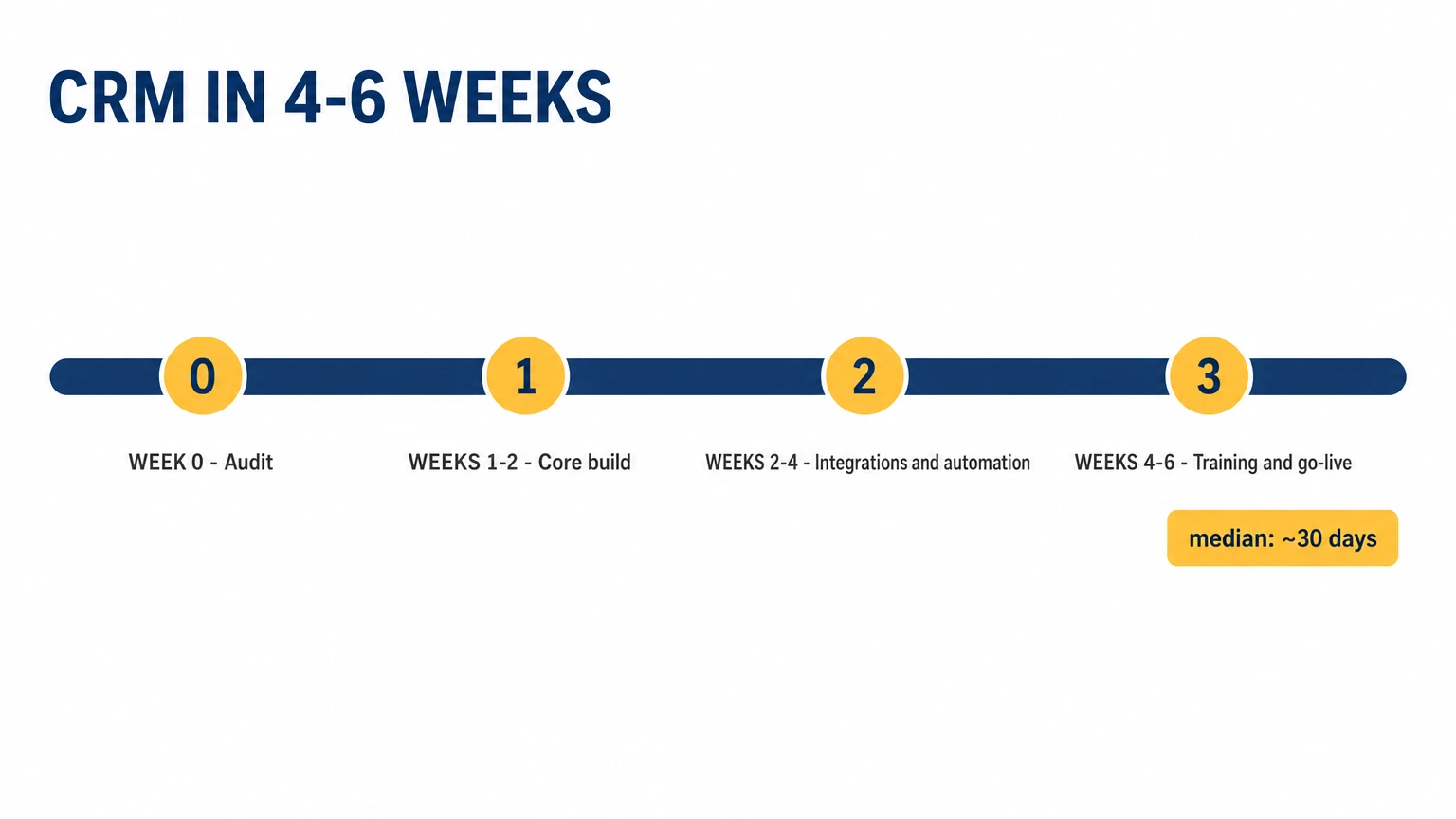
Week 0: the audit, before anyone touches the software
Two to three days mapping how the work actually flows — sources, stages, handoffs, the spreadsheet everyone secretly relies on. This is a service of its own, the CRM audit, and every project starts there.
Out of this comes a one-page picture of the pipeline and a short list of what to fix first. Why we do not automate a broken process, and what all eight rollout steps look like, is in the companion note linked below.
Weeks 1–2: the core build
Pipelines, stages, required fields, roles and access. The CRM starts to look like your business rather than a demo. Data import begins in parallel — and this is where timelines live or die, because dirty data (duplicates, three formats of phone number, a decade of free-text) takes longer to clean than anything else.
By the end of week two there is a working system with your real contacts in it, that one or two people can already use.
Weeks 2–4: integrations and automation
The channels come in — telephony, WhatsApp, web forms, email — so leads land automatically. Then the automation: reminders, status notifications, handoffs between people, document templates. The aim is to remove the manual steps that made the old way exhausting.
This is also where task management and internal chat get wired, so the team runs the work in one place instead of a dozen group chats.
Weeks 4–6: integrations, training, go-live and the real test
The system is ready before the team is — that is normal. We train on the actual workflows, not a generic tour, then go live and watch the first week closely. The first three days surface every habit the design missed; we adjust fast.
Go-live is not the finish line. Adoption is. A CRM nobody opens is just an expensive database.
Why is the median about 30 days?
A focused single-team rollout with clean-ish data and a decision-maker who answers quickly lands in two to four weeks, with a median around 30 days. What stretches it to six weeks is integrations, large data volumes and the normal friction — holidays, a busy season, data that turns out messier than promised, a stakeholder who needs a second look.
What actually slows it down?
Almost never the technology. It is dirty data, a process no one will commit to, and the decision that keeps getting postponed. The fastest projects are not the simplest — they are the ones with one clear owner on the client side who can say yes.