
Starting point: why were orders getting lost in chat threads?
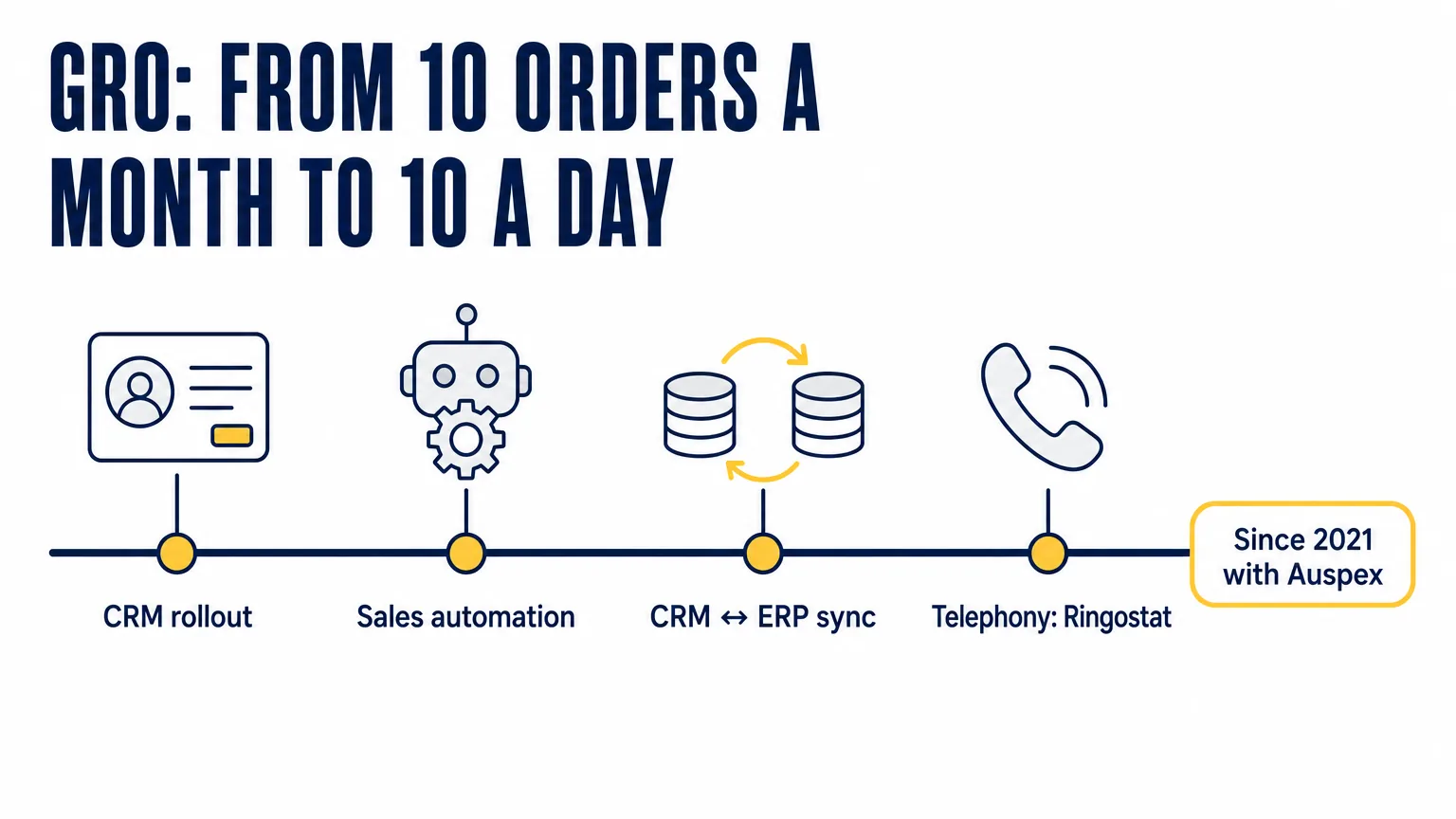
In 2021 GRO handled about 10 website orders a month — and even that volume was already painful. Inquiries lived in separate comment threads: each one needed clarifications, information lookups, and a manually assembled reply. There was no process control, and some orders simply got lost.
The company approached the choice systematically, reviewing and comparing 5–10 CRM integrators. In the Ringostat case study, GRO's development director Andrii Kachalaba attributes the choice of Auspex to speed and clear communication at every stage — down to how quickly invoicing arrangements were settled.
What did Auspex do?
We work as a full-cycle integrator. Here is the sequence we went through with GRO:
- Interviews and process mapping: what already works in the company and what belongs in the CRM.
- Selecting a CRM to fit the needs — not a habit of favoring one platform.
- Standard configuration that requires no engineers.
- Custom development where standard functionality falls short.
- Team training: without user skills, no system delivers productivity.
We do not name the CRM platform behind GRO's portal in this piece: it does not appear in the public Ringostat case study, and we have no separate consent to disclose it.
Once the basics were live, the second, larger stage began: synchronizing the CRM with the ERP system. That is what closed the core pains of a growing e-commerce operation — systematic lead handling, correct order creation, and automated order processing. Managers stopped re-typing data between systems, and the business could grow at its own pace.
With GRO the initial request was standard system configuration; later we started a large-scale CRM-to-ERP synchronization project — helping the business grow and develop at a pace comfortable for it.
— Andrew Maryasov, CEO of Auspex (quoted from the Ringostat case study)
CRM + telephony: where did Ringostat come in?
In Ukrainian e-commerce, reaction speed decides the sale: fail to answer within 5 minutes in chat — or instantly on the phone — and the customer is most likely gone. GRO had a technical obstacle at the start: calls initiated from the CRM took 10 to 90 seconds to connect. Moving to Ringostat's virtual telephony removed the delay and added parallel calls, routing to the responsible manager, and call tracking — dynamic number insertion on the website plus static numbers for social channels.
CRM and telephony operate as one system: communication history, call recordings, and call sources are attached to the customer rather than scattered across channels. That is the omnichannel setup the whole project was about: a customer writes on Viber, continues on Instagram, then calls — and the manager sees one story, not three.
What were the results?
- Order volume: from ~10 a month to ~10 a day.
- Average call length is about 1 minute 20 seconds: managers have context, redundant clarifications are gone.
- Ad budgets grew roughly a hundredfold alongside the business — guided by call-tracking data.
- Customer acquisition cost, fixed in hryvnia, has stayed flat for five years. All four figures above come from the GRO team as quoted in the Ringostat case study; Auspex has no independent measurement behind them.
To be fair about attribution: this growth is first of all the work of the GRO team. The role of CRM, ERP sync, and telephony is that the growth stayed manageable — volumes multiplied dozens of times and the processes held.
Auspex is a full-cycle CRM integrator: 1,500+ projects for 1,200+ companies since 2015, a median go-live of 30 days, and 15+ technology partners. If your e-commerce operation is stuck in manual order processing, start with a process audit.