
What is the report everyone cites for the 95% actually about?
In August 2025, MIT Project NANDA published “The GenAI Divide: State of AI in Business 2025.” One number from it went into circulation: with businesses spending $30–40 billion on generative AI, 95% of organizations got zero return.
The methodology is worth reading before you lean on the number. The research rests on three legs: a systematic review of more than 300 publicly disclosed AI initiatives, structured interviews with representatives of 52 organizations, and 153 survey responses from executives, collected at four industry conferences. The authors themselves warn that the percentages reflect a sample of 52 organizations and may not describe the market as a whole; on top of that, the definition of success varied from company to company.
The authors name the cause without softening it: the main barrier is not integration, not budget and not a shortage of specialists, but organizational design. In the section on team structure the wording is harsher still — success depends less on resources than on decentralizing authority with a clearly assigned owner.
Who started the most successful deployments?
Many of the strongest enterprise deployments began with power users, employees who had already experimented with tools like ChatGPT or Claude for personal productivity.
— MIT Project NANDA, The GenAI Divide, 2025
The same paragraph of the report goes on to explain why it was them. These people intuitively understood both what the tool could do and where its limits lay, so they became early champions of solutions that were already officially sanctioned. Rather than relying on a central AI function, successful organizations let budget holders and domain managers surface problems, vet tools and lead rollouts themselves.
In the report's conclusions this point sits next to two others: the companies that crossed the “divide” bought solutions rather than building their own; gave authority to line managers rather than central labs; and chose tools that integrate deeply into the work and change along with it.
- demanded customization to their internal processes and their own data rather than a one-size-fits-all solution
- judged tools on operational outcomes, not model benchmarks
- worked through early failures together with the vendor, treating the rollout as co-evolution
- took ideas from line managers, not from a central lab
What did Every's hundred companies show?
Natalia Quintero heads the consulting practice at the media company Every. By her account, since joining she has talked with more than a hundred organizations — startups, hedge funds managing billions, creative agencies, private equity firms, media companies — about their difficulties with AI adoption. In December 2025 she described what she hears in those conversations, almost word for word the same each time: the tools are there, a few power users are there, and what to do next is unclear.
Her diagnosis is not the expected one. The problem is clarity: executives have no articulated answer to what they want to achieve, so they can't say where AI comes in.
You can only automate what you can clearly define.
— Natalia Quintero, Every
The second half of her piece is behind a paywall, so only the open part is quoted here.
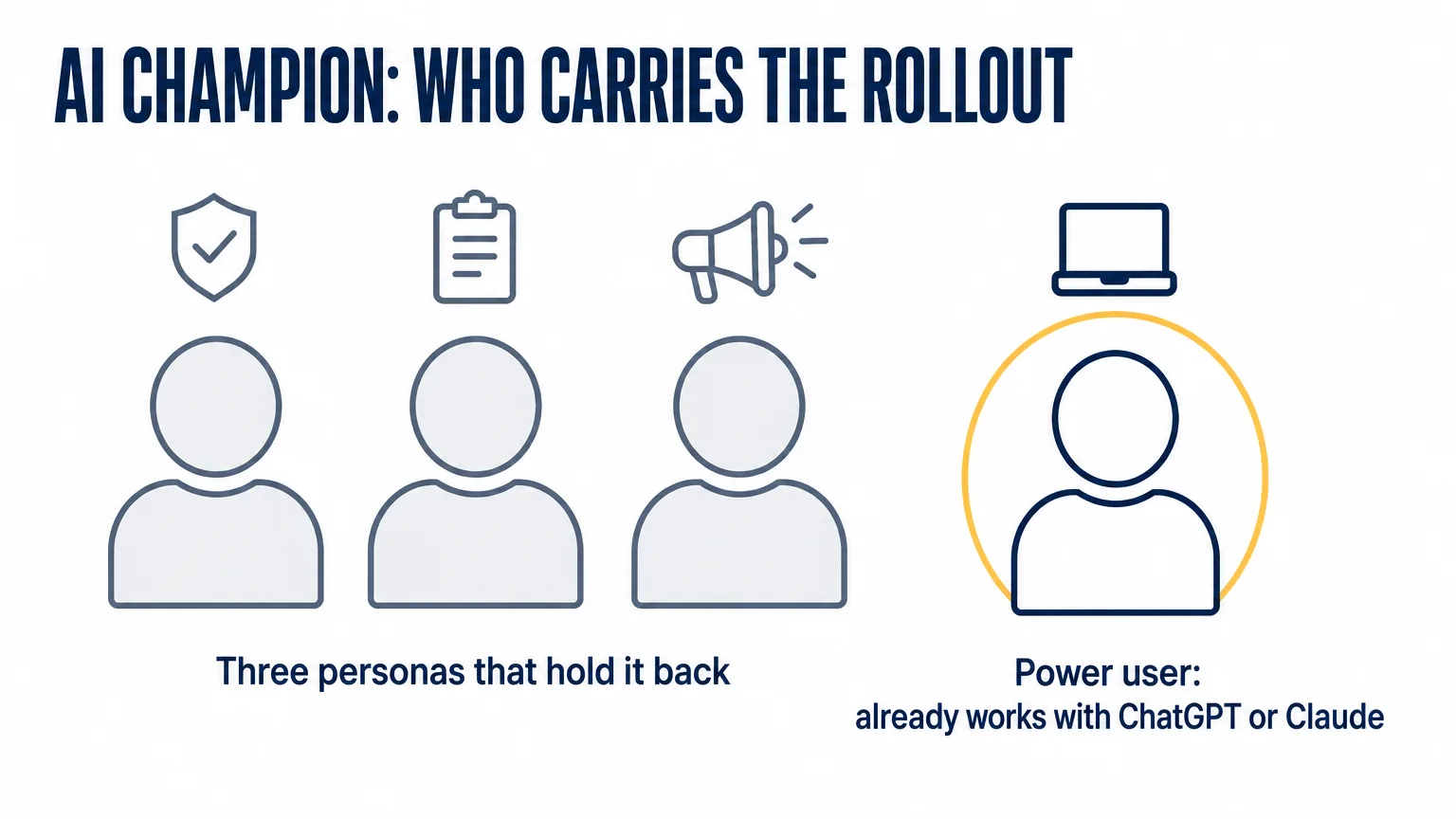
Which three personas hold things back — and which one is easy to miss?
When Quintero dug into why people don't use AI at work regularly, three types emerged.
- The skeptics. They are uncomfortable with new technology and doubt it will work at all. At many companies usage starts out high and then drops off quickly — once it sinks in that this is a new skill and learning it will take a long time.
- The overwhelmed. The tools are there, and the desire may be too, but the person is drowning in day-to-day work. One answer from her interviews: “If you talk to me about prompt engineering, I'm going to cry.”
- The tool-jumpers. Analysis paralysis disguised as progress: they evaluate thirty tools, switch platforms, chase releases and master none of them. One firm said it had struggled to get documents into ChatGPT, so its teams switched to Perplexity. The tool changed; the adoption problem stayed.
The fourth type doesn't hold anything back — which is exactly why it is easy to miss. Every calls it the lonely power user: someone who has found how AI changes their work, gets real value from it and is completely isolated all the same. The reason isn't personality. AI doesn't spread the way other software does: if one person sets up a task tracker for the team, everyone benefits automatically, because order in the tasks is visible from the outside and nobody has to learn the tool. With AI it's different — your prompts, your workflows, your automations are built around your context and your way of thinking. They don't transfer.
What exactly does an AI champion do in a real case?
Quintero's most detailed example comes from Every's AI & I podcast (February 2026): a private equity client. A partner at the firm, called Jonathan on the episode page, combined two things that rarely live in one person: a technical understanding of AI and an understanding of the people dynamics around it. The second means he saw that different teams inside the same firm move at different speeds, depending on how much capacity they have left for experiments.
Together with the Every team, he sat down with every investor at the firm and mapped out in detail everything that person does: research, due diligence, market mapping, portfolio management. From that map they picked the places with the most leverage. The most time-consuming task turned out to be sifting through investment theses accumulated over more than ten years and applying the current strategy to them. Once the right data sources were connected to ChatGPT and run through a set of custom prompts, a draft investment memo started taking 30 minutes instead of three weeks.
That's only possible when you have someone on the inside who understands all of the elements.
— Natalia Quintero, AI & I podcast (Every)
He didn't choose a model and he didn't write an integration. He talked to every colleague and drew up a map of the work — exactly what neither an outside contractor nor a boss at the top will do.
Why did the same answer turn up twenty-three years earlier?
When Auspex traced where the figure everyone quotes about failed CRM implementations came from, the most detailed of those studies turned out to be a joint piece of work by CRMGuru.com, Mangen Research Associates and Caribou Lake Customer-1, published in 2002. It identified four factors that decide payback. Second on the list is front-line involvement.
The way those authors put it sounds as if it were written about AI: you can't force a sales rep to use a tool, but you can show them that the system takes part of the work off their plate — and which part exactly, you only find out by asking them at the design stage. None of the four factors is software.
Who is not an AI champion?
When a company decides to “do AI,” the role goes to one of four people. The system administrator — who knows how the software is built and doesn't know how a sales rep actually runs a deal. The loudest enthusiast — but enthusiasm doesn't give you the right to change a procedure. An outside contractor, meaning us — and we see the process only as far as it was shown to us during the audit. Or the person formally appointed to be responsible for digitalization, who personally has no pain that this automation would relieve.
Putting the two sources together, you can recognize a champion by two things that aren't in the job description. They have done this work with their own hands, so they know it in detail rather than from a process description. And they see that the department next door moves more slowly, but put it down to a difference in spare time, not sabotage. Two other signs — that the person has already automated something for themselves and that they have enough authority to change a rule — are tested by the questions below.
How do you find an AI champion in a team of 10–200 people?
There's no need to announce a contest. Four questions are enough, and the answers to them already exist inside the company.
- Who has already automated something for themselves, without your knowledge? MIT calls this shadow AI and notes that this kind of do-it-yourself work often delivers a better return than official initiatives, because it shows where the pain really is.
- Which of your domain managers can tell you today's number for their process — how many requests come in per week, how many hours it takes to answer them?
- Who, in the last conversation about a new tool, talked about their process rather than the tool itself?
- Who has enough authority to change a rule, not just to ask for a change?
In a team of 10–200 people, there is one person who passes all four questions. Sometimes there are none — then the rollout is worth postponing until someone appears. Every, meanwhile, insists on the other side of the same coin: Dan Shipper says an organization will go exactly as far into AI as its leader has gone, and that this can't be delegated. The two don't contradict each other. The leader sets how far you can go; the champion, what goes first.
Why doesn't a contractor replace the champion, or the champion the contractor?
Auspex is a CRM implementation and business process automation company: 1,500+ projects for 1,200+ companies since 2015. In our process, the first step is a conversation and watching how the business actually operates; the system demo comes later. The question “who here has already set something up for themselves” is asked at that same step, and the answer is worth more than it seems: it shows which process to start with.
We don't implement “a CRM”; we implement one specific process, and on the client's side that process has to have an owner with a name. An honest acceptance criterion reads “the team works in the CRM.” The wording “the pipeline is configured” leaves the risk of nobody using it with the client; one word of difference moves that risk to the contractor. Without a champion on the inside, that criterion is hard to meet, and it's worth knowing before you sign. If the next step after the process is an AI agent, it is built by Grow2.ai — our AI division.
How to find a champion inside your team
- Write down who on your team has done something with AI in the last three months without being asked by you. That is your list of candidates, and it is rarely longer than two names.
- Pick one process that hurts this person personally, and name today's number for it.
- Give them two hours a week of working time and put those hours in the calendar — otherwise they won't materialize.
The last item looks like the cheapest and falls through most often. Quintero fell into this trap herself at the end of 2025: her days were packed with meetings and client work, leaving no time to figure out new tools. She found the way out outside the working day — she started getting up at six in the morning to code alongside an Every engineer. Out of those mornings came an agent named Claudie that handles her project management: the weekly load of that routine dropped from fifteen hours to one. It didn't reach a working state right away — by her account, three times they got it 85% of the way there, threw it out and started over.
If you already know who that person is on your team, the next question is which single process to launch first and what its number is today. That is the subject of one conversation, not a project: send us the name of the process and we'll go through it on a call. Everything that comes after that conversation is laid out in the eight steps of our rollout.
Sources
- MIT NANDA — The GenAI Divide: State of AI in Business 2025 (MIT Media Lab, NANDA group)
- Every — I Talked to More Than 100 Companies About AI — Here's What's Actually Working (Natalia Quintero)
- MIT Project NANDA — The GenAI Divide: State of AI in Business 2025
- Every — Every's Head of Consulting Just Automated Her Job (4 February 2026)
- ZDNet — CRM failures: don't blame the tools (2002)