
What is a Forward Deployed Engineer?
A Forward Deployed Engineer (FDE) is an engineer embedded in a client's organization to tune a general technology to that client's specific data, permissions and workflows until it starts producing a useful business result. The role covers the whole chain: work out the requirements, write the code, integrate the system, launch it and work next to the end users. What separates an FDE from a consultant is ownership of the rollout and the result, rather than a report and a handshake on the way out.
The model isn't new. Palantir invented it two decades ago, sending engineers to work directly on the customer's site. What's new is the context: in 2026 the role was rediscovered for AI. Andrew Ng, writing in The Batch, described the AI Forward Deployed Engineer as one of Silicon Valley's hottest new jobs — an engineer embedded in the client's organization who builds and tunes agentic workflows for the needs of one specific business. Beyond the technical skills, that person has to talk to the customer, set priorities, and push back with an argument when the client asks for the impossible.
Why are OpenAI, Anthropic and Google suddenly fighting over this role?
The reason is simple: AI models are fast becoming a commodity, and the real value sits in making a model work inside a company. A chatbot demo is easy. Rebuilding a company's workflow around AI is not. The FDE lives in that gap between "AI can" and "AI works here".
In May 2026 OpenAI announced a services company of its own — OpenAI Deployment Company — with more than $4 billion in initial investment, built on the purchase of the British engineering firm Tomoro along with roughly 150 forward-deployed engineers. At almost the same time, Anthropic launched a separate enterprise AI services firm together with Blackstone, Hellman & Friedman and Goldman Sachs. Google Cloud, under Thomas Kurian, opened its own AI-focused team and, as of mid-2026, had 59 FDE roles posted in the US and abroad.
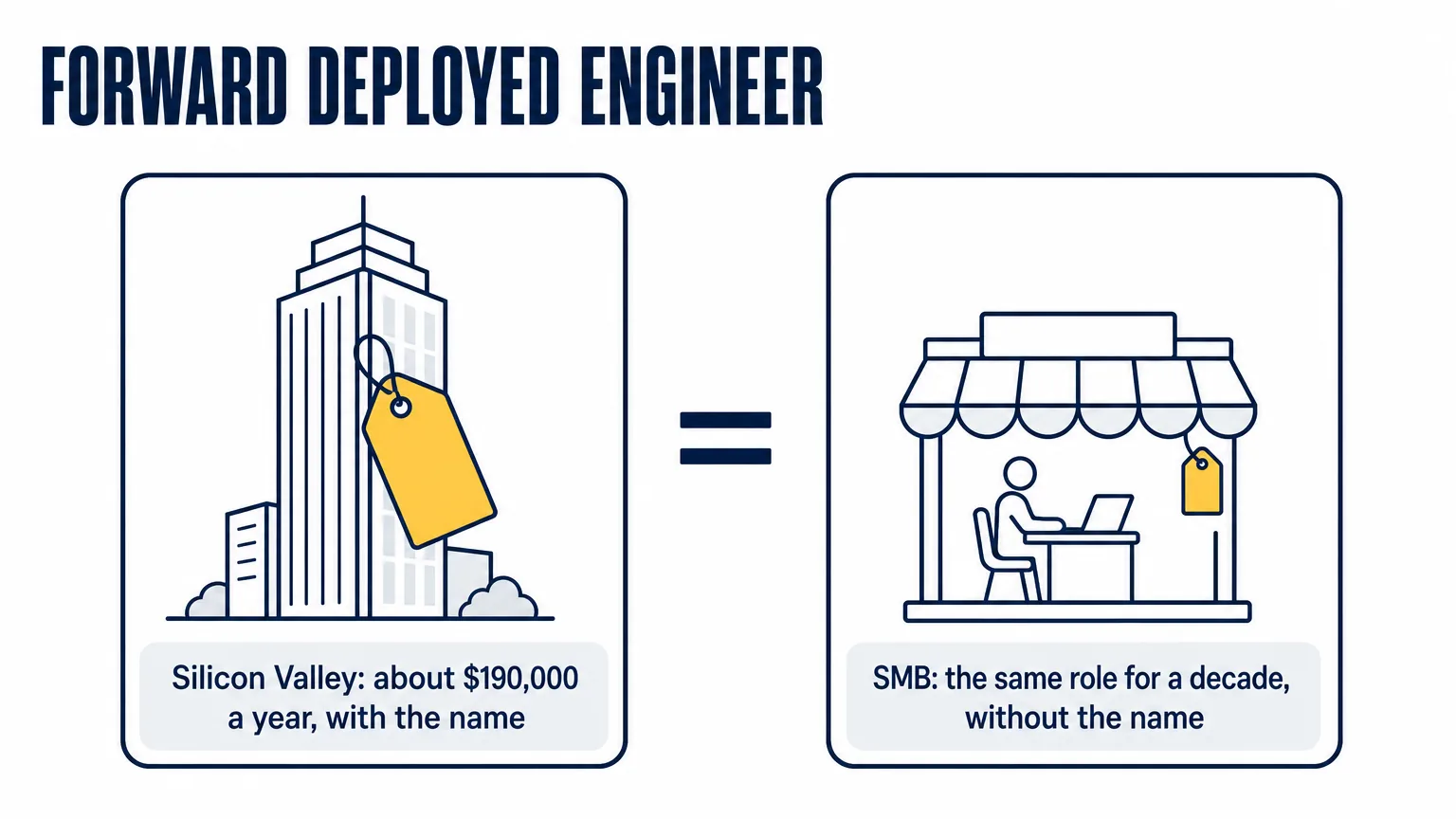
The labor market says the same thing in numbers. Indeed data cited by Business Insider puts the forward deployed engineer postings index in April 2026 at 5,230% above the January 2025 baseline, against 543% above it a year earlier in April 2025 — roughly a 729% year-over-year increase. Median base salary in 2026 is around $190,000, and packages at the top companies reach several hundred thousand. A cosmetic trend does not explain this: three of the largest AI labs are betting that the competitive edge has moved from the model to its deployment.
Why is this the same job an integrator does for an SMB?
Take the words "AI model" and "Silicon Valley" out of the FDE description and what's left is an exact portrait of the implementation partner small businesses live on. The engineer comes inside the company, works out how the team really operates, fits the system to those processes, launches it and stays around until it sticks. The only difference is the size of the client and the title on the business card.
Enterprise buys this role from Palantir or OpenAI at hundreds of thousands of dollars per engineer. An SMB buys it by typing "turnkey CRM implementation for small business" or "business process automation" into a search box. Different wording, same need: someone who takes a general platform and drives it to a working result in one specific business. The automation partner's job is the FDE role, minus the loud name.
What is an SMB really buying when it asks for a turnkey CRM?
When an owner says "we need a CRM", they rarely mean the CRM itself. The license is a commodity: Bitrix24 Standard costs about €87 a month for a team of up to 50, and that price saves nobody from a failed rollout. Development hours aren't worth paying for either — code that gets written and then abandoned turns into technical debt within six months, and by then nobody in the company understands it.
What an SMB actually buys is an engineer who sits inside the process and owns the path from event to result. Not a platform and not hours, but a person who translates "this is how we sell" into the language of the system, migrates the data, trains the team and stays reachable when something breaks in week two. That's the core of the FDE role, under a sign that reads "implementation partner".
Which two familiar models don't deliver this?
The first one is "we sold you the license, you're on your own". The reseller sets up the subscription, shows a couple of videos and disappears. A month later the team quietly goes back to Excel and chat apps, because nobody built the system into its daily work. The second is "code delivered, goodbye". A freelancer or an agency hands over a technically working product and leaves, and the business is alone with a solution nobody is left to maintain or grow.
FDE mode differs in one thing — the engineer stays inside the process and carries the result, not the fact of delivery. Not "the system has been handed over" but "the process now runs". The distance between those two phrasings is what Silicon Valley suddenly started paying premium money for in 2026.
What's the flip side: vendor lock-in?
The FDE model carries a real risk, and Andrew Ng flags it separately: by definition, the engineer weaves one particular vendor's product deep into the company. That lowers optionality — the freedom to pick a different system once a better one turns up. For the client it's a hidden price: the deeper a solution is embedded, the more expensive it is to get off it.
Auspex — a CRM implementation and automation brand for small business, working since 2015 — takes that risk off the table by starting with diagnostics instead of a sale. We implement on Uspacy, monday.com, Pipedrive and Zoho, and in EU markets on Bitrix24 as a Gold Partner. Bitrix24 is unavailable in Ukraine: there we support existing portals and run a managed transition whenever the team is ready for one. Systems get compared on official data, with no referral interest: first we find out which process hurts and what shouldn't be touched at all, and only then recommend a system to fit the job — not a job to fit the system.
What does the FDE role look like at Auspex in practice?
We break a rollout into separate processes, and each one goes through its own demo and sign-off. That's FDE logic in miniature: the engineer stays on after installation and carries every process — from issuing invoices to answering a lead — to the point where it runs end to end, from event to result. A failure shows up in week two, not a year later when the money is already spent.
Once the boring layer is closed and the processes produce clean data, there's ground for AI agents — handling routine requests, pre-qualification, first-line support. Grow2.ai, our AI division, builds that layer, and in FDE mode too: an agent on top of chaos inherits the chaos, so order in the processes comes before autonomy. Measurable results first; the flashy part when there's something solid to put it on.
Not sure who you're actually hiring under the label "turnkey CRM"? Start with a process audit: 30 minutes of conversation shows which process hurts most, what pays back fastest, and whether you need new software at all or just some order in what you already have.
Sources
- OpenAI — OpenAI launches the Deployment Company
- Anthropic — Building a new enterprise AI services company with Blackstone, Hellman & Friedman, and Goldman Sachs
- Channel Dive — Google Cloud is hiring an army of AI deployment engineers
- Business Insider — Job postings for this tech role have grown more than 700% in the last year (Indeed data)
- Bitrix24 — official pricing (European storefront, euros)