
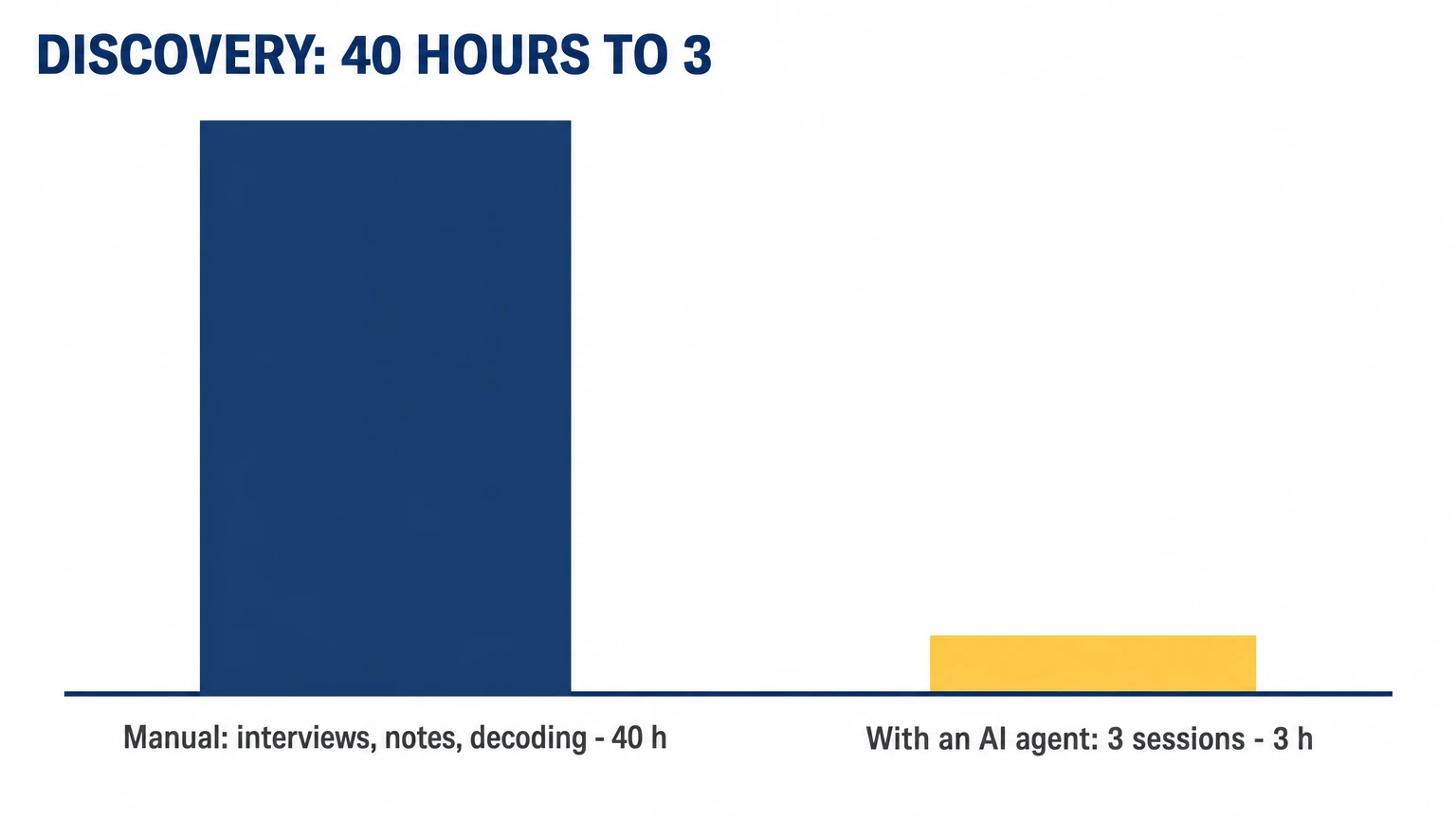
Where do the 40 hours actually go?
Twelve meetings. Notes scattered across five documents. Half the answers contradict the other half — and at the final meeting the client is genuinely puzzled: “didn't we already go over this?” The problem isn't the clients. The consultant asks a question, writes it down, loses the context a week later, and asks again. The client gets tired, answers on the surface — and then can't understand why the system does “the wrong thing.”
Which part of this is just routine?
At this stage the consultant mostly works like a voice recorder with a notepad: writing down answers and trying not to forget anything. Thinking and making decisions is human work. Recording and structuring isn't. That's exactly the part we handed off to an agent.
What does the agent do?
It is a full-fledged interviewer with a nine-module, 67-question methodology, not a chatbot for frequently asked questions. It runs a structured discovery across three sessions with breaks between them, adapts the depth of its questions to the size of the company, takes text, voice notes and even files — and notices on its own when answers contradict each other.
The output isn't just a report. After each session the client gets an interim summary for their own use, and at the end it generates a finished technical spec — already tailored to the specific system that will be rolled out, built from all of that system's documentation. From there, the document just needs a quick sign-off before configuration can begin.
How do three sessions replace forty hours?
Three sessions of 45–60 minutes instead of 40 hours of a consultant's time. The client answers at a comfortable pace, the agent forgets nothing, and every answer turns into technical requirements automatically. One of our first clients said: “love that I can do it by voice — dictated half the answers on my drive to work.”
What was the unexpected effect?
With a bot, clients answer more honestly than with a live consultant. There's no social pressure to give the “right” answer, no sense of being judged. And that changes the quality of the input — and, in turn, the quality of the spec itself.
That same client, by the way, admitted that at first he couldn't tell what the question plan would be or what was coming next. We fixed it in a day — now the agent shows the specific questions in each module upfront.
The discovery agent in this article is an internal tool of ours, but the logic itself scales further: custom AI agents for a client's specific process — from handling inbound requests to front-office work — are built by Grow2.ai, our AI division. Discovery is just the first step wherever routine work is worth handing to an agent.