
Bitrix24 vs monday.com
Which is the better CRM: Bitrix24 or monday.com?
Bitrix24 is the stronger CRM of the two. It ships a native CRM with leads, deals, products, quotes and invoices, native telephony with IVR, call recording and calling from the CRM, and open channels for WhatsApp, Instagram and Telegram included in the license. monday.com's CRM is a board template: it handles contacts and deal stages well, but there is no native telephony and no deal-to-quote-to-invoice flow, so those pieces arrive through third-party integrations or Zapier. Pricing follows the same shape. Bitrix24 sells flat user buckets of 5, 50 or 100 seats in the cloud or on-premise; monday.com sells per-seat tiers with a three-seat minimum and cloud only. If your hard problem is sales pipeline, telephony and customer communication, Bitrix24 wins on both product depth and cost per seat.
When is monday.com the right call instead of Bitrix24?
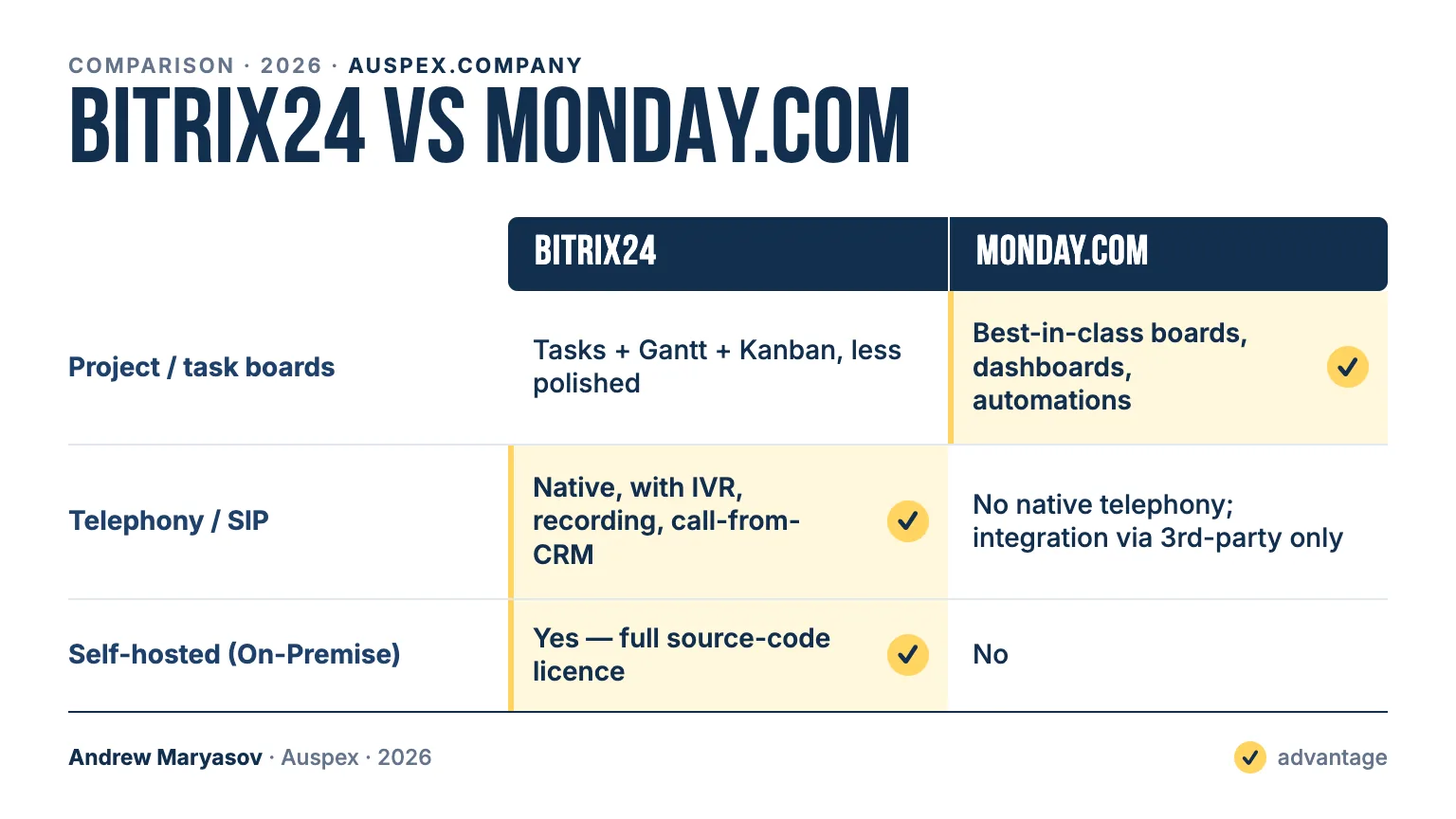
monday.com wins when the core problem is cross-team project visibility and CRM is a side need. Its boards, dashboards and board automations are among the most mature on the market, the mobile app is polished and mobile-first, and a project workspace goes live in one to two weeks, or three to four if a CRM is added; Bitrix24 tasks with Gantt and Kanban are capable but less polished, and an SMB CRM rollout takes Auspex two to four weeks. Workflow automation is a tie of different kinds: Bitrix24 offers a visual BPM designer, an open API and webhooks, monday.com is strong inside boards and weaker across apps. Two boundaries matter. Bitrix24 is the only one with a self-hosted, full-source-code license, and since June 2023 it is unavailable to companies operating in Ukraine under NSDC sanctions. Running both tools for a 30-person SMB doubles license cost without doubling value.
| Feature | Bitrix24 | monday.com | Winner |
|---|---|---|---|
| Pricing model | Flat user-bucket (5 / 50 / 100), Cloud or On-Premise | Per-seat tiers, 3-seat minimum, Cloud only | Bitrix24 |
| CRM depth | Native CRM with leads, deals, products, quotes, invoices | CRM is a board template; missing telephony, deals-quote-invoice flow | Bitrix24 |
| Project / task boards | Tasks + Gantt + Kanban, less polished | Among the most mature boards, dashboards and automations | monday.com |
| Telephony / SIP | Native, with IVR, recording, call-from-CRM | No native telephony; integration via 3rd-party only | Bitrix24 |
| Open channels (WhatsApp, Instagram, Telegram) | Native, included | Via integrations / Zapier | Bitrix24 |
| Workflow automation | Visual BPM + open API + webhooks | Strong board automations; weaker for cross-app workflows | tie |
| Time-to-go-live (Auspex) | 2–4 weeks for SMB CRM | 1–2 weeks for project boards, 3–4 if also CRM | monday.com |
| Self-hosted (On-Premise) | Yes — full source-code license | No | Bitrix24 |
| Mobile UX | Solid, occasionally heavy | Polished, mobile-first | monday.com |
Pick Bitrix24 if sales pipeline, telephony, and customer comms are your core problem. Pick monday.com if cross-team project visibility is the core problem and CRM is a side-need. Mixing both for a 30-person SMB doubles license cost without doubling value. Note: since June 2023 Bitrix24 is unavailable to companies operating in Ukraine (NSDC sanctions) — Ukrainian teams should start from our Ukraine CRM guide.
Frequently asked
Can I run Bitrix24 for CRM and monday.com for project management together?
Technically yes, but it rarely makes sense. For 90% of SMBs it is wrong — you pay for two systems, train staff on two UIs, and end up with the customer record split. Pick one, and bend it to both jobs.
Which one is cheaper for a 25-person team?
Bitrix24 — Standard at flat fee covers 50 users; monday.com Pro is per-seat, so 25 users cost roughly 3× more on annual TCO. The price gap closes if you only need monday.com Basic without CRM features.
We are pure agency / pure tech — does monday.com win for us?
For agencies and tech teams whose primary daily workflow is project visibility (timelines, milestones, dependencies) with light CRM, yes — monday.com is built for that exact shape and is a strong pick there. Auspex implements monday.com as well as Bitrix24, so both reads here come from delivery.
What about migration between them?
Doable in either direction in 2–4 weeks for SMB-scale data. Pipelines and contacts map cleanly; custom dashboards and complex automations always need rebuilding because the underlying primitives differ.