
A rep fills in the CRM when it speeds up their work
While preparing the course "CRM for the owner", Auspex went through 30 articles on why reps do not keep the CRM up to date: 16 of them put it down to the benefit for the rep, and only 2 take the opposite view. The course gives this a lesson of its own. The benefit is concrete: a website inquiry becomes a deal by itself, the customer's number dials from the card, the conversation history survives a colleague leaving, and getting all of that takes a few fields instead of twenty.
Without the benefit the system turns into reporting for the manager. The rep does the work twice: first sells, then describes how they sold. The best sellers in that situation keep live deals in a notebook and update the CRM on Friday with the minimum of data. The pipeline in the report looks full, and the owner forecasts on it.
47 clicks per deal: what the digikat audit showed
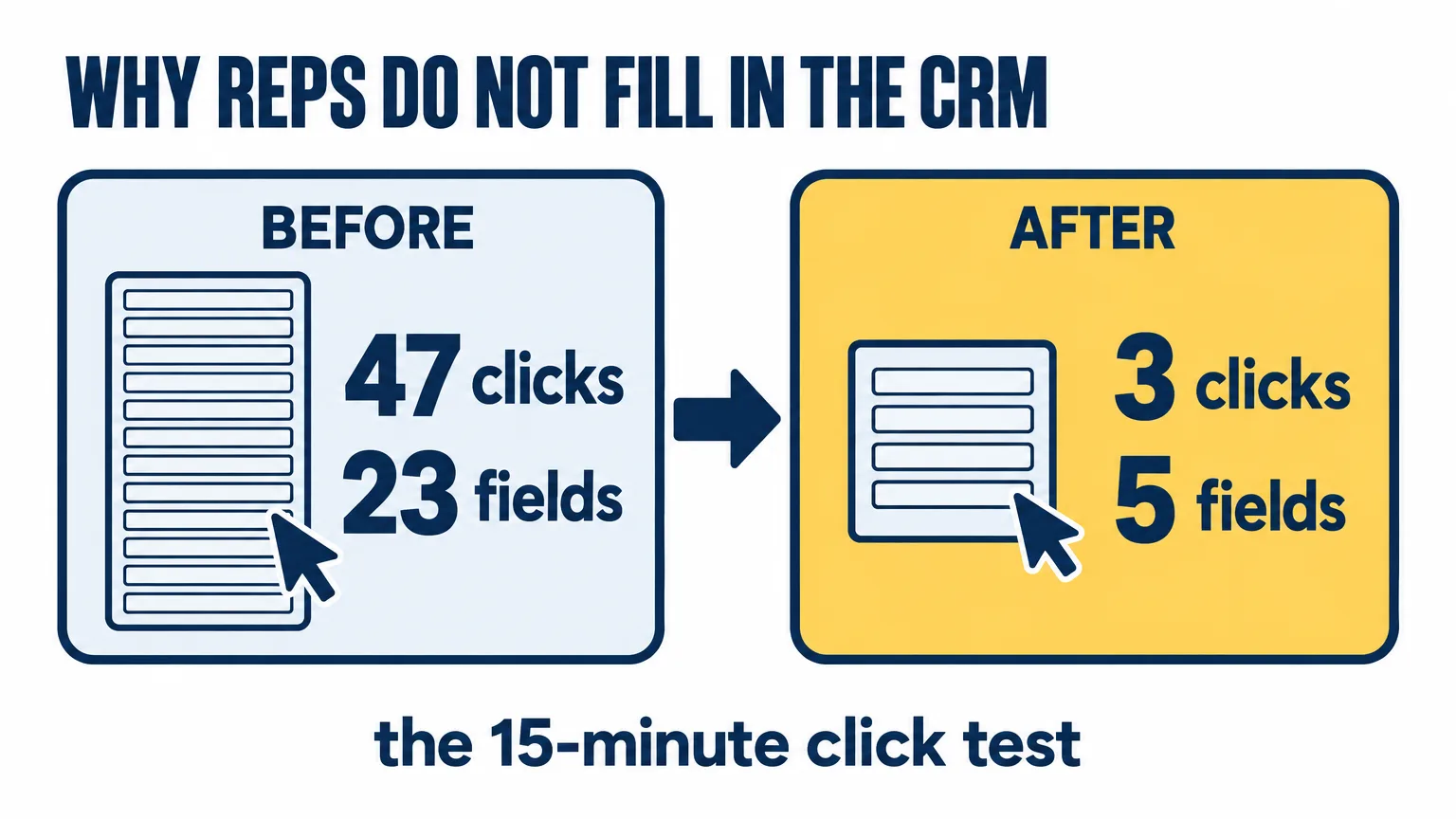
A digikat consultant asked a client's rep to show how they create a deal. It took 47 clicks and 23 required fields. After simplification 3 clicks and 5 fields remained, and the other 18 were filled by automated workflows over the life of the deal. The share of the team using the CRM rose, by their data, from 23 to 94 percent. It is one case from one consultant, not market statistics, but the mechanism is universal: the same people, the same system, a different input design.
We reduced that software company's deal creation from 47 clicks to 3. Required fields went from 23 to 5. The other 18 fields? We built workflows to populate them automatically over the deal lifecycle.
— digikat, 2026
Fields accumulate without malice. Marketing asks for the lead source, accounting for the company ID, the manager for the loss reason, the owner for the segment. Each field is justified on its own; together they make twenty required fields at the start of a deal, when the rep knows only the customer's name and phone.
Why fines and bonuses do not help
The opposite approach exists and has supporters: Salesjam puts it as "not in the CRM, it did not happen" and advises tying bonuses to entries in the system. Entries do appear after that. The question is what is in them.
Validity surveyed CRM administrators: in companies where decision-makers rely on data, 54 percent of respondents say staff manipulate data to tell the story decision-makers want to hear. When a bonus depends on a field, the field is filled so that the bonus happens. Control without benefit yields not an empty CRM but one full of groomed numbers, and that is worse: nobody trusts an empty CRM, the owner trusts a groomed one.
The 15-minute click test
- Ask one rep to create a deal from a new inquiry while you watch. Count the clicks, the required fields and the time. Then do the same for "log a call result" and "move the deal to the next stage".
- Ask which field they fill "to tick the box". The answer comes instantly; reps know those fields by heart.
- For every required field write down who needs it and which decision rests on it. A field with no answer in the "why" column is a candidate for auto-fill or for leaving the required list.
- Repeat the test a month after the changes. The benchmark from the digikat case: three actions in a few clicks and 4–5 required fields at the start, the rest appearing at later stages.
The two-step "Click Test" template is in the Google Sheets below (in Ukrainian). Filled in, it becomes the change list for the CRM administrator: what to make optional, what to auto-fill, what to remove.
The "who and why" rule
Every required field has an answer to two questions: who needs it and which decision rests on it. "Lead source" is needed by marketing to decide where the budget goes, and it can be auto-filled from the form or UTM. "Customer segment" is needed by the owner for a quarterly report, and it can be set at the invoice stage rather than the first call. "Manager's comment" is needed by nobody; it is filled "to tick the box".
- Required at the start: only what the deal cannot move to the next stage without. Usually contact, channel, amount or product.
- Required at a stage: the field becomes mandatory when it is actually needed. The loss reason is needed at closing, so nobody asks for it at creation.
- Automatic: source, date, owner, deal name built from product and customer. The system does this.
- Optional or removed: everything with no answer to "why".
Control without fines
When reps benefit from working in the system, its numbers reflect reality and can be looked at: deals and amounts by stage, conversion, deals with no movement. Control like that rests on the benefit to the rep, and it needs no fines. If the CRM is already in place and the team works around it, the click test shows the first step within an hour; in a harder case Auspex does it in a 2–3-day CRM audit together with the processes and the data.
Sources
- digikat, 2026. Your CRM Is a Mirror: deal creation cut from 47 clicks and 23 required fields to 3 and 5, CRM adoption from 23 % to 94 % (their data)
- Validity, 2024. The State of CRM Data Management: 54 % of CRM admins say staff manipulate data to tell the story decision-makers want to hear
- Salesjam, 2025. Why reps do not enter customers into the CRM: the opposite stance, "not in the CRM, it did not happen"
- SYNTECH. Why reps ignore the CRM: manual data entry as the main cause of low adoption
Author: Andrew Maryasov, founder of Auspex. Auspex has implemented CRM since 2015: 1,500+ projects for 1,200+ companies; in Ukraine it works with Uspacy.