
A pipeline stage is a deal state, not a rep's activity
A sales pipeline stage answers "where is this deal now", not "what did the rep do today". A call, an email, a reminder are activities, they go into the activity log. A stage is a state a deal enters on a verifiable condition and leaves on the next one. Without a condition the stage becomes subjective: one rep moves a deal after the first conversation, another after the second, and the stage-to-stage conversion in the report compares the incomparable.
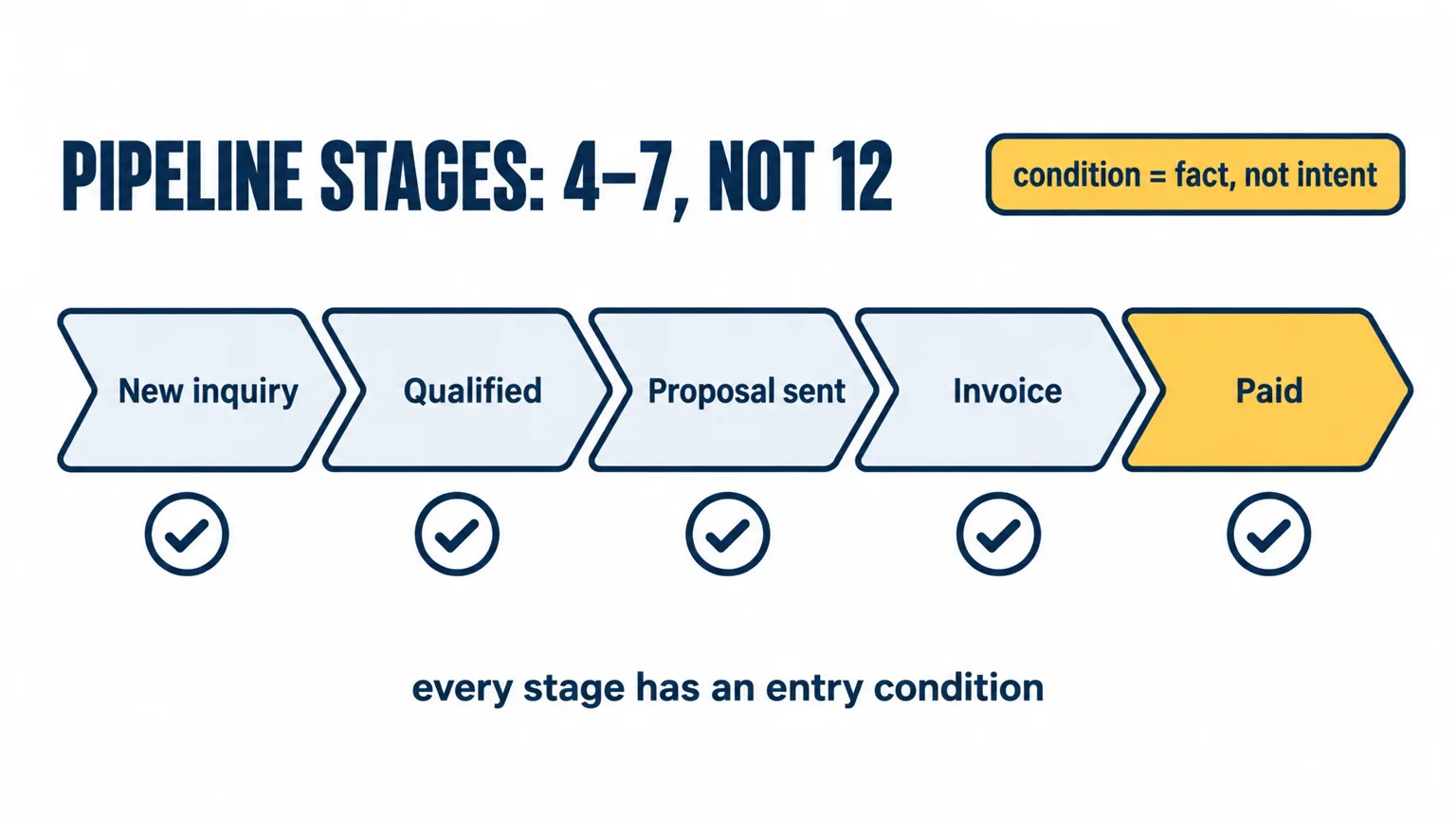
So the rule is simple: there are as many stages as there are verifiable states between the first contact and the money. In most 10–200-person companies that comes to four to seven.
Why twelve stages are worse than five
AKORDO describes a familiar picture: a detailed twelve-stage pipeline looks precise, but reps skip some statuses or update them retroactively before the meeting so the report looks tidy. Every extra stage is one more field to remember and one more point where the pipeline drifts from reality.
A detailed pipeline with twelve stages looks precise, but in practice reps simply skip some statuses or update them retroactively before the meeting.
— AKORDO, 2026, translated from Ukrainian
The test for a redundant stage is simple: if the rep's action does not change between two neighboring stages, merge them. "Proposal in progress" and "Proposal sent" are one stage with the condition "quote sent to the customer". "Thinking" and "Still thinking" are not stages either: they are a next-step date.
Example: a five-stage pipeline with entry conditions
For services and invoice-based B2B sales a working pipeline looks like this. Each stage has an entry condition that can be verified, and someone who verifies it:
- New inquiry. Condition: a contact and the channel it came from exist. Verified by the system or whoever took the inquiry.
- Qualified. Condition: need, budget and timeline are known. Verified by the rep, who writes the three answers into the card.
- Proposal sent. Condition: the quote has been sent and a next-contact date is set. Verified by the rep, with the proof in email or messenger.
- Invoice. Condition: an invoice has been issued. Verified by the system or the accountant.
- Paid. Condition: the money has arrived. Verified by accounting or the bank, not the rep.
An online store has a different pipeline: order, confirmed, paid, shipped, received. In manufacturing a contract appears between proposal and invoice. The essence is the same: every stage has a verifiable fact at the entrance. "The rep feels the customer is warm" is not a condition, and a stage with such a condition merges into its neighbor.
How to write an entry condition
- The condition names a fact, not an intention: "quote sent", not "agreed to send a quote".
- The fact leaves a trace: a document, a date, an amount, a log entry. No trace, no way to verify.
- Every condition has someone who verifies it. For "paid" that is accounting or the bank: when a rep sets "paid", the company ends up with two "paid" statuses and the owner does not know which to trust.
- The last field before the transition becomes mandatory at that stage, not from day one. That leaves four or five mandatory fields at the start instead of twenty.
Response time: measure to a live conversation, not to an auto-reply
Response speed deserves a rule, but it has to be measured correctly. Workato submitted demo requests to 114 B2B companies: one sent a personalized email within five minutes, and on average such an email arrived after 11 hours 54 minutes. That is their measurement of the B2B market, not Ukrainian small business, but the picture is familiar.
Meanwhile Synapsa took apart the study behind the "five-minute rule": it measured not response speed but whether a conversation happened. A ten-second auto-reply turns the metric green without producing a single extra conversation. So measure time to the first live conversation and look at the median: one inquiry forgotten over the weekend skews the average by hours.
A ten-minute test
- Submit a test inquiry on your own website or in the company messenger and time it to the first live conversation; the auto-reply does not count. Repeat on different days and look at the median.
- Write out your pipeline stages as they stand in the CRM or spreadsheet. Next to each, write the entry condition and who verifies it.
- Merge a stage without a condition into its neighbor. Do the same for stages where the rep's action does not change.
- Open the stage report for the last year: a stage no deal has passed through is either redundant or has an impossible entry condition.
The "Stage → entry condition" template and the "Stopwatch" sheet are in the Google Sheets below (in Ukrainian): ten minutes to fill in, and it becomes the specification for configuring the pipeline, yourself or with an integrator.
What the owner gets
Once stages have entry conditions, stage-to-stage conversion becomes a number you can trust: 40 percent from "qualified" to "proposal sent" means exactly that, with no allowance for how the rep felt. Three such numbers make up the owner's screen: deals and amounts by stage, conversion between stages, deals with no movement. Without entry conditions any dashboard, however pretty, shows what reps think of their own deals. If your pipeline has already drifted from reality, Auspex takes it apart in a 2–3-day CRM audit together with the processes and the data.
Sources
- AKORDO, 2026. Sales pipeline stages in a CRM: twelve stages that get updated retroactively before the meeting
- Workato, 2026. B2B Lead Response Times: demo requests to 114 B2B companies, one personalized email within 5 minutes, 11 hours 54 minutes on average (their measurement)
- Synapsa, 2026. Why Speed to Lead Is the Wrong Pipeline Conversion Metric: the study behind the "five-minute rule" measured conversations, not replies
Author: Andrew Maryasov, founder of Auspex. Auspex has implemented CRM since 2015: 1,500+ projects for 1,200+ companies; in Ukraine it works with Uspacy.