
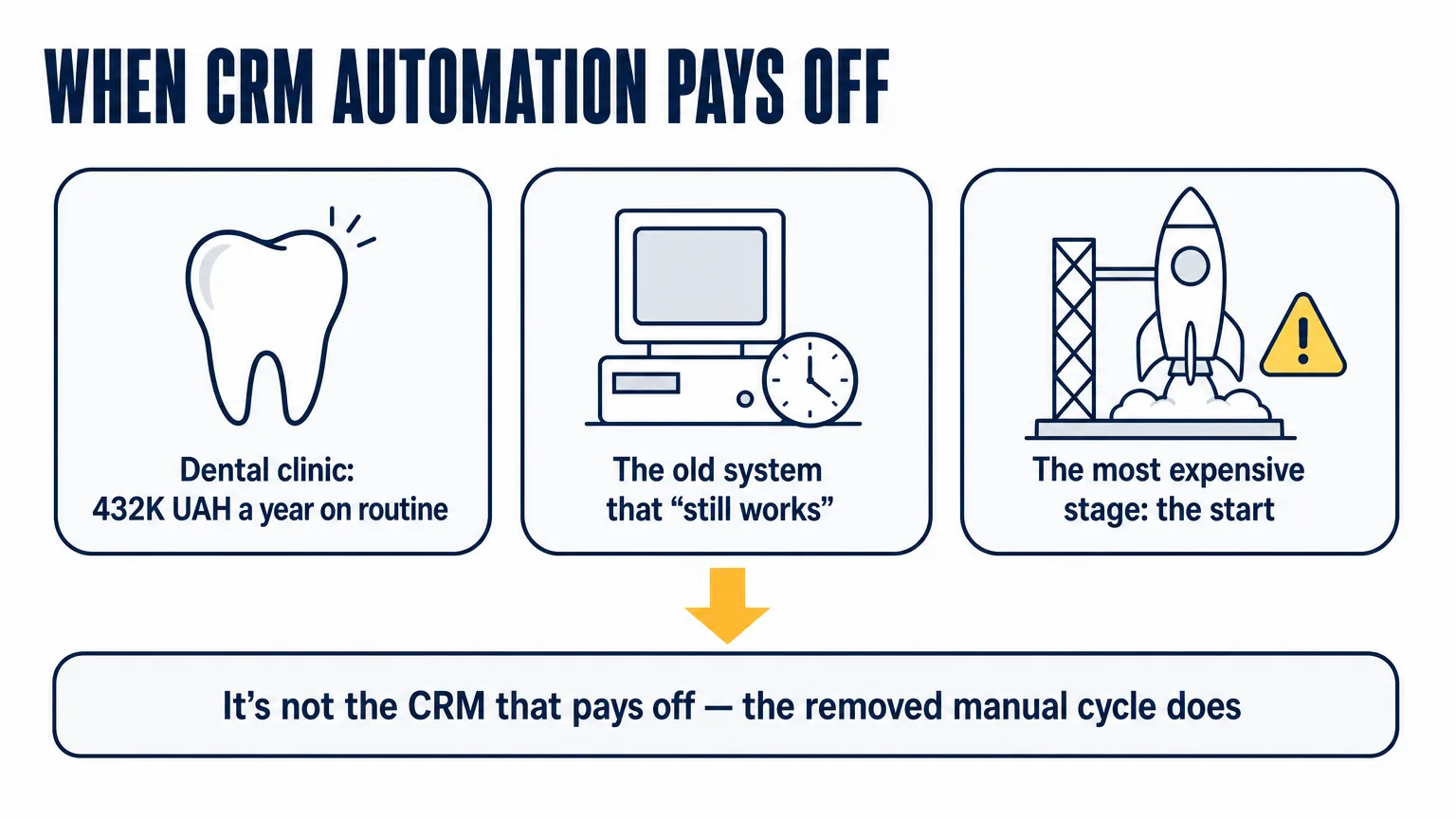
No single post can answer it. Each case shows one economy, while “will it pay off for me” requires seeing different ones side by side: money lost in dropped leads, money buried in maintaining an old system, and hours burned daily on the accept-record-transfer-remind cycle. Here are three stories with three different economies.
Story one: a dental clinic — 432K UAH a year on routine
A calculation from a real commercial proposal. The client is not named and the project is at proposal stage: everything below is a forecast, not a delivered result. Two administrators cost the clinic 432,000 UAH a year, and about 60% of their work is repetitive requests: book, reschedule, clarify. Add after-hours bookings the clinic currently never sees — roughly another 50,000 UAH of potential monthly revenue.
Project cost in that proposal — 142,000 UAH, estimated payback — about three months. Note what pays off here: not “a CRM” but the cycle taken off people's hands.
Story two: the old system that “still works”
A financial calculator on Zoho Creator: it calculated, generated PDFs, but every new feature was painful and third-party services ate about €50 a month. We rewrote it on a modern stack in a few days: native PDF, new features, no per-user pricing lock-in. This is a story about the cost of evolving a system, not about payback: we do not disclose what the rewrite itself cost — only the €50 a month the client no longer pays.
Story three: the start that cost forty hours
A classic pre-project discovery is 40+ consultant hours and twelve meetings. Our own internal AI agent runs it in three sessions; the full account is in the companion piece linked below. For this article only the economics matter: the money here sat in the hours the project start itself consumed, not in dropped leads or a subscription. Custom AI agents built around a client's process are built by Grow2.ai, our AI division.
The pattern: what actually pays off?
Three stories, three different places where the money sat. In the first it sat in dropped leads: after-hours requests the clinic never saw. In the second, in the cost of keeping an old system alive, where every new feature hurt and a third-party service billed every month. In the third, in the hours spent on the accept-record-transfer-remind cycle people crank by hand every day. What pays off is not “a CRM” but one specific item from those three.
Why does “it's easier to do it by hand” still win? It is a trap, not economy: habit, mental-effort saving in the moment, and discounting of future gains all work at once. And a CRM without automation is a notebook with a nice interface.
Self-diagnosis: which three questions should you ask?
- Which cycle do your people crank by hand every day — and how many hours a week does it eat?
- How many requests arrive outside working hours — and what happens to them now?
- How much does it cost, and how long do you wait, when your current system needs a new feature?
Where is the limit of this route — and what next?
Three stories show the pattern, but they do not know your economy. Where exactly your most expensive manual cycle sits, and whether to replace or reconfigure your current system, is only visible from inside the business.
You can do the sums yourself: take the three questions above, add up the yearly price of your manual cycles and compare it with a project's cost. If the numbers roughly meet, you already have a business case.
If there is no time to calculate or the numbers come out debatable, come to a pre-project discovery with Auspex: we return the calculation on your numbers, not on market averages. The service page is in the links below.