
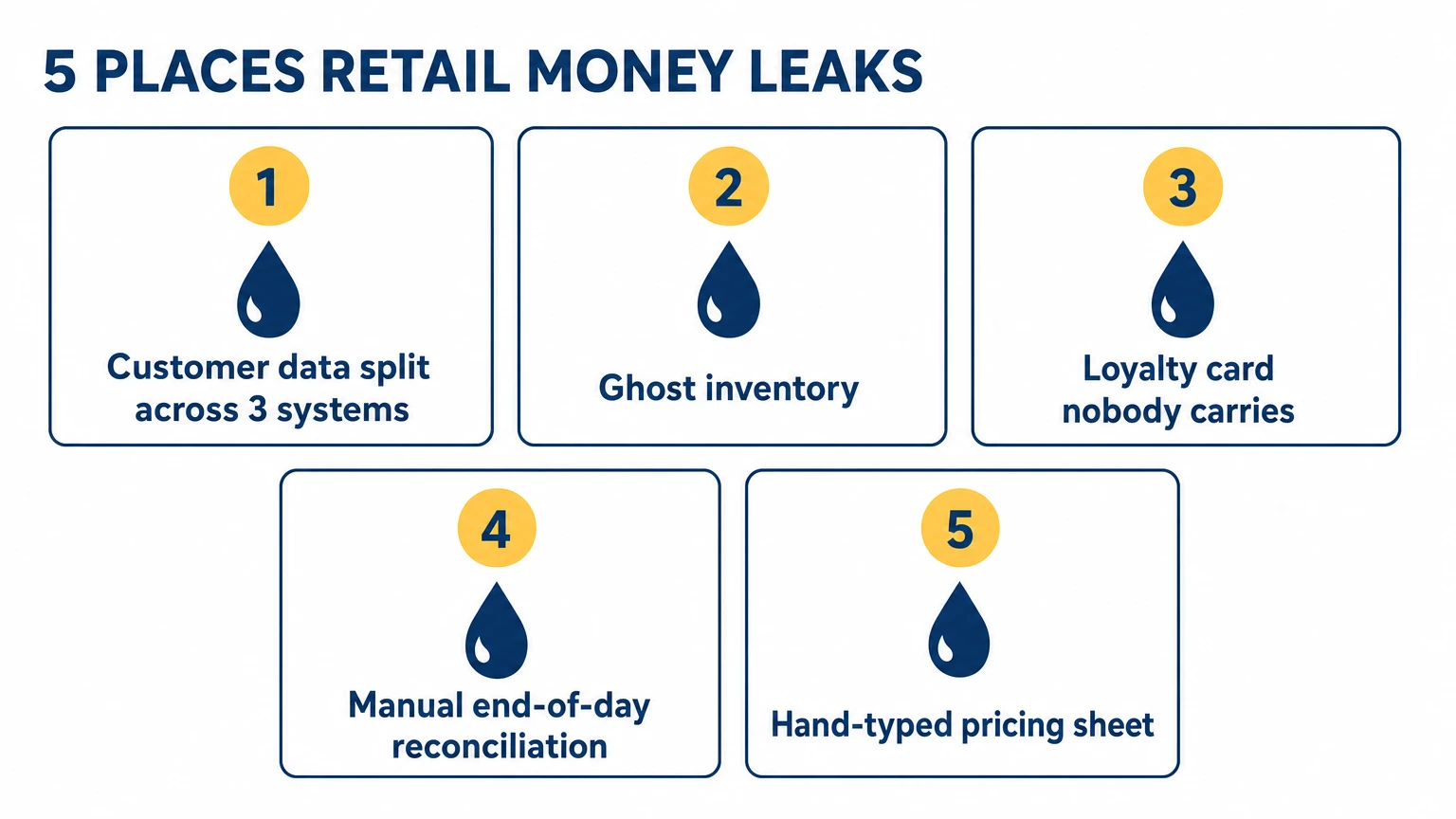
Five scenes — do you recognize yours?
- The customer record split across three systems: a loyal customer is Maria at the till, @maria_88 in your e-shop, and a stranger when she DMs your Instagram. Three records, three histories, no segmentation and no retargeting.
- Ghost inventory: the POS shows three units, the floor shows zero, and nobody flags it until sales drop the following week. The owner finds out at month-end, when the variance has already become a write-down.
- The loyalty card nobody carries: the plastic stayed at home, the customer cannot remember her points, and redeeming needs a receipt. The owner concludes loyalty does not work in retail. It works — just not the way it was built.
- Manual end-of-day reconciliation: the cashier stays an hour late counting, the Z-report goes into a folder, and the owner sees the daily P&L the next morning, when it is too late to act.
- The hand-typed Excel pricing sheet: 1,800 SKUs updated twice a year, re-uploaded to the POS, the e-shop forgotten — and the chain discounts the new collection at the wrong margin for two weeks.
What to look at in your reports for each scene
- How many contacts in your database share a phone number — that is your duplicate rate on the customer record.
- The gap between book stock and the physical count at your last inventory, broken out for your top SKUs.
- The share of receipts where points were applied against all receipts from programme members — and how many were rung up with no card at all.
- What time your daily P&L appears, and how many minutes the cashier spends closing the shift.
- How many places hold the price for one SKU, and when each of them was last updated.
What Auspex does about it
- Dedupe by phone number, unify into one CRM contact, write back to every channel. We budget 4–7 days to rebuild the customer card for a single store.
- Stock from the till reaches the CRM in real time, low-stock triggers fire, and supplier reorders are generated automatically. The owner sees what is moving from a phone — the same data the floor manager sees.
- Phone-number-based loyalty inside the CRM: the cashier types six digits, points apply, then an automated post-purchase flow at 14 days and re-engagement at 60. Point redemption after the rebuild is the headline metric of the programme — measured on your numbers.
- A nightly sync from the till to accounting and the CRM: the daily P&L lands by 21:00 automatically, in a chat the owner already reads.
- A single source of truth — the CRM product catalogue or a dedicated PIM — pushed to the POS, the e-shop and marketplace listings. One change, one place, propagated everywhere.
What's the pattern?
None of these are technology problems on the surface. They are workflow problems. Technology is needed exactly where a person spends a year typing the same number into three systems. Pull that person out of the loop, and the leaks close themselves.
If two of these five sound familiar — that is the audit. The other three are usually next door.