
STREAMLINE

Automations that pay for themselves in the first month.

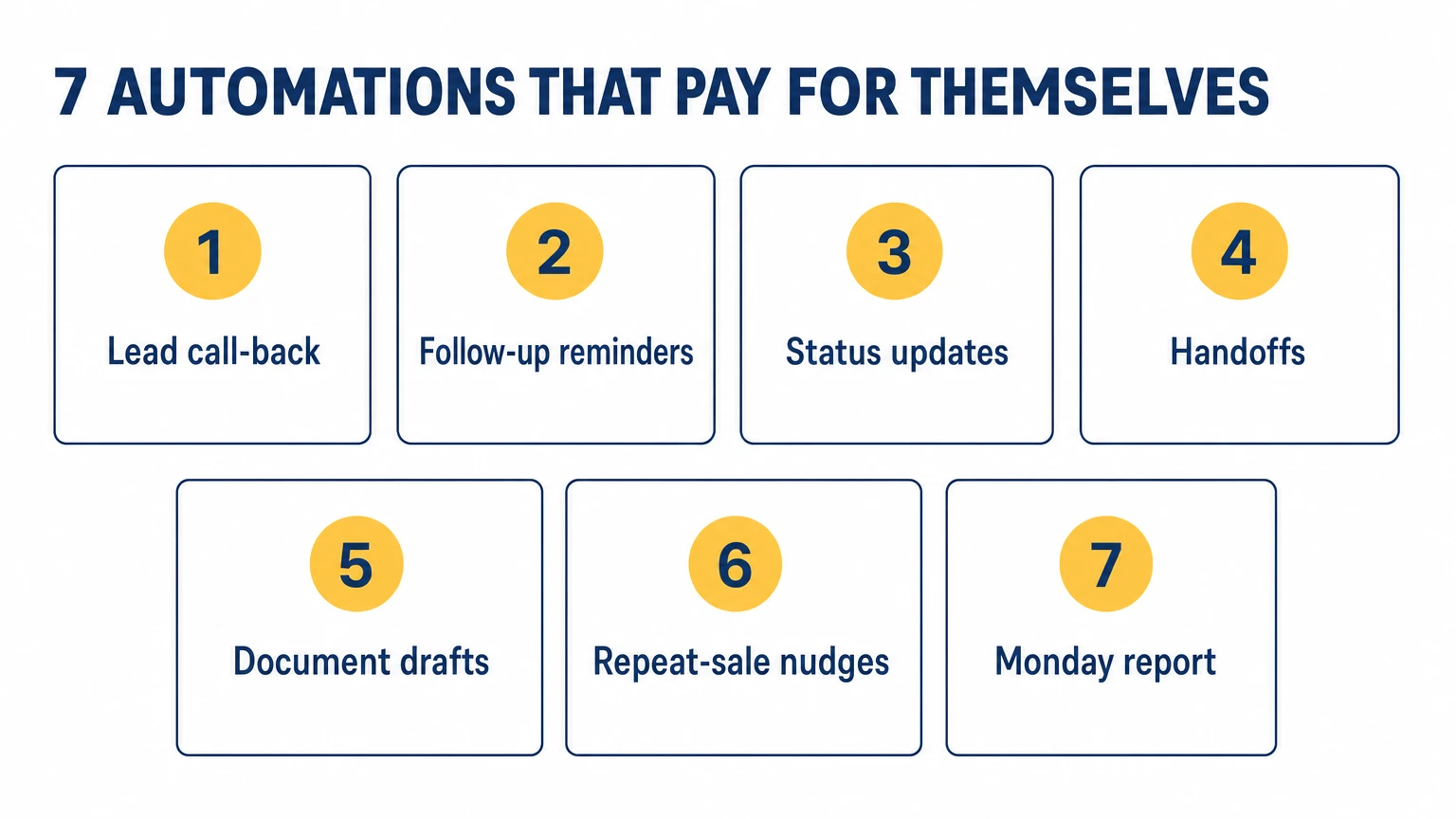
1. The lead nobody called back.

A lead comes in at 19:40, the team sees it at 10:00 the next day, and by then a faster competitor has it. An auto-assignment plus a “new lead, call within X minutes” task closes the response-time gap that quietly loses the most deals of anything on this list.

Typical return: faster first contact, measured in hours saved per lead and a higher share of leads actually worked — usually visible in the first two weeks.

2. The follow-up that depends on memory.

Most deals need three to five touches; most salespeople do one or two and move on. A reminder sequence tied to the deal stage means the follow-up happens whether or not anyone remembers — which is where the “found money” in a tired pipeline usually is.

3. The status update done by hand.

Someone calls or messages the client at every stage: “your order shipped”, “your documents are ready”. Automate the status-change notification and you free that person’s day and make the client feel informed without a single manual message.

4. The handoff between people.

Sales to onboarding, intake to fulfilment, one department to the next. Automate the transition — the next task opens for the right person with the context attached — and you close the gap where work silently stalls for days.

5. The document typed from scratch.

Quotes, invoices, contracts, acts — retyped each time, with the occasional wrong number. One-click generation from the CRM record turns 20 minutes of copy-paste into a few seconds, and removes the embarrassing mistakes.

6. The customers you already won and forgot.

Your cheapest sale is to someone who already bought. A reactivation flow — a message at 60 or 90 days, a service reminder by date or mileage — reliably pulls revenue out of a base that was just sitting there.

7. The report someone builds every Monday.

A person spends two hours assembling a dashboard from three exports. Automate it and the same numbers land on their own, every morning, in a chat the manager already reads. Two hours a week back, every week.

How to pick the first one.

Start where it hurts and where it repeats. The best first automation is the manual task your team does many times a day and resents — not the most impressive one. Win there, earn the trust, and the next five are easy.

Rule of thumb: if a person does it more than ten times a week and hates it, it is an automation candidate. If it happens once a quarter, leave it alone.

Frequently asked

Do we need a fancy CRM for this?

No. All seven run on mainstream systems — Bitrix24, Uspacy, Pipedrive, Zoho and similar. The value is in the workflow design, not an exotic platform. We build on what you already have where we can.

How fast can the first ones go live?

The simple, high-value ones — auto-assignment, reminders, status notifications — are usually live within the first week or two of a rollout. The heavier ones (document generation, cross-system handoffs) come once the data and integrations are in place.

What does automation cost?

Automation work starts around €200 and scales with the number and complexity of workflows. Because the first automations target daily manual tasks, most clients see the time saved cover the cost inside the first month or two.

Free CRM audit →
↳ FREE AUDIT 30 min · free · ↓

Ready to Get Your Sales Under Control?

Free process audit — 30 minutes, and you'll receive:

You keep the loss map and the implementation plan after 30 minutes — even if you never become a client. No obligations.

1,200+ companies since 2015 · 30-day median go-live

01 A map of where you're losing leads
02 Priorities: what to automate first
03 An implementation plan for 2-4 weeks
We'll call within 24 hours. The plan is yours, even if we don't work together.