
What are the two roles of a good salesperson?
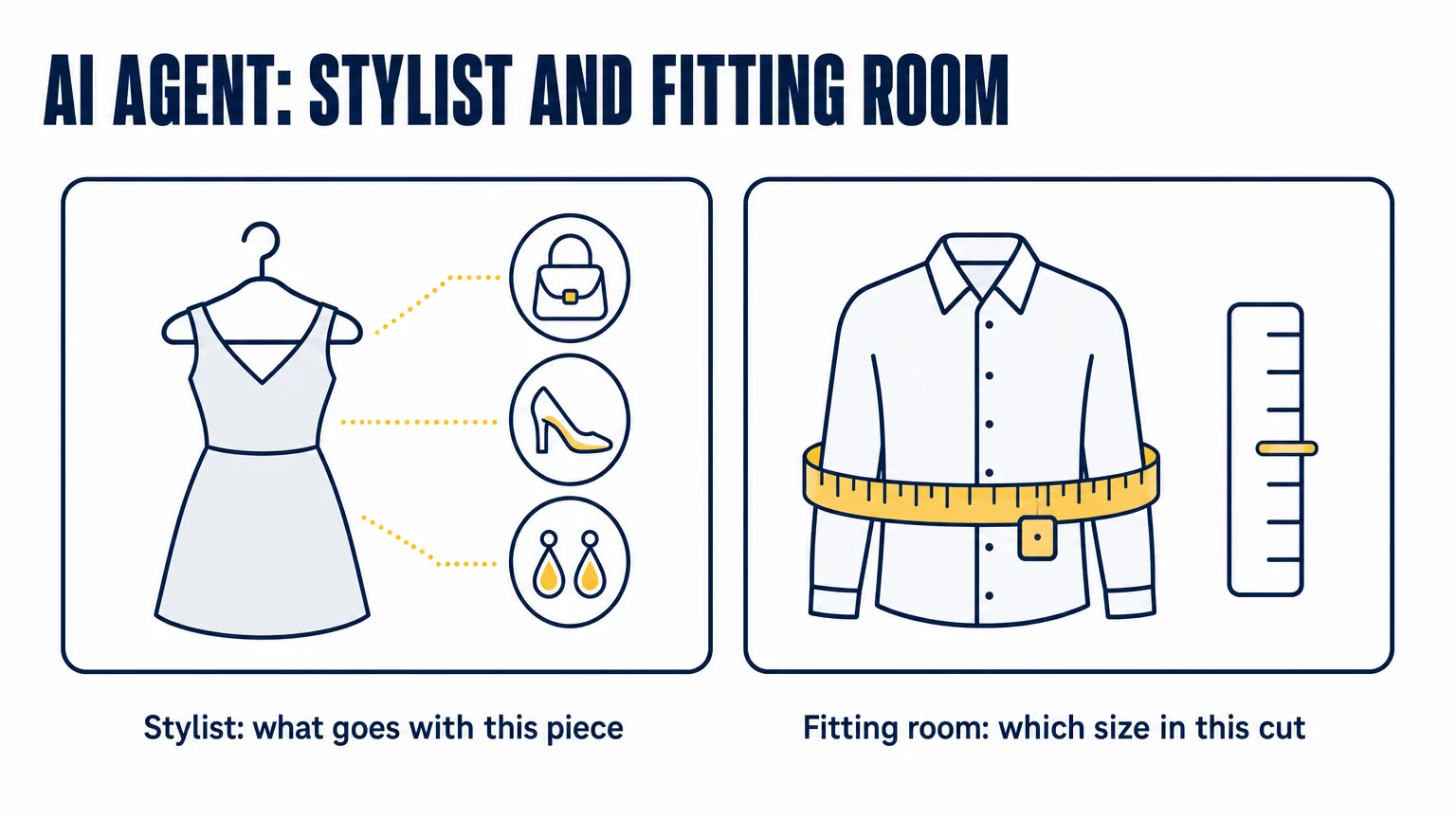
A good salesperson never says “here is your dress, goodbye”. They say: “have you seen this belt? It is from the same collection. And this bag is simply perfect with it”. And you think: “it really does go”. Because the salesperson knows the collection, knows what pairs with what, and senses the moment when a suggestion is welcome — not a hard sell, a genuine suggestion.
The same salesperson also closes the second question — size. One look at the customer, a question about what they are after, and: “take this in a 44, and the trousers in a 46 — that is how the cut runs”. A stylist and a fitting room in one person.
Why does online lose this?
Now open any online clothing store and pull up a dress page. What sits under it? A “similar items” block — ten more dresses just like it. Or “others also bought” — a random set with no styling logic whatsoever. And instead of size advice, a chart: S/M/L, 42/44/46, figure it out yourself. “Similar items” is an algorithm. A stylist is knowledge. And the customer is left alone with both questions.
Part one: how does the stylist agent work?
The agent for this chain of 30+ clothing stores was taught to be a stylist, not a recommendation engine. It does not show some abstract “popular now” — it works with the exact piece the customer is choosing right now.
- Knows which accessories go with a specific piece: bags, belts, jewellery, scarves.
- Understands the logic of the collection — pieces from the same line pair best.
- Senses the moment: knows when a suggestion is welcome and when it is better to stay quiet.
- Keeps the sale in mind — if a fitting item happens to be discounted, it will mention that.
The foundation is always “complete the look”, not “buy more”. The difference between “similar items” and “this belt from the new collection goes with this dress” is the difference between statistics and expertise.
Part two: the fitting room, or why isn't size a number?
One of the most common reasons for returns in online clothing stores is not “did not like it” and not complaints about quality, but a size that did not fit. It looks simple enough: there is a size chart, after all. But the same M sits completely differently in an oversized blouse and a fitted one. And the top can be an M while the bottom is an L — that is not a “figure error”, that is normal.
An experienced salesperson holds all of this in their head, which is why in a store the size question is settled in a minute. The online shopper is left alone with a table of numbers instead. The agent reproduces the salesperson's logic step by step:
- First it explains how to take measurements properly with a measuring tape — with instructions, because most people do it wrong.
- It accounts for the cut of the specific model: oversized, fitted, semi-fitted.
- It distinguishes top size from bottom size — if the customer is choosing both a blouse and trousers, the recommendations will differ.
- It compares the customer's actual measurements with the numbers for the specific model and names the optimal size.
This is not “plug the numbers into a chart”. This is expertise a salesperson builds over years — and there is no way to scale it across thirty stores and a night shift. In the agent it is simply encoded, and it works everywhere at once.
What does this give the business?
An upsell that sounds like a stylist's advice, not like “buy something else”. Size selection that targets the most common reason for returns. And the expertise of the best salesperson, available around the clock across the whole chain — in every channel, night shift included. Missed upsells and returns are two of the holes through which retail quietly loses money.
We do not disclose the outcome figures here, by agreement with the client; the full case, with dialogue volumes and cost per dialogue, is published on the Grow2.ai site.
The agent in this case is built for one specific chain — its collections, its cuts, its size charts. It was built by Grow2.ai, our AI division; Auspex owned the CRM and the process underneath it. The full case, with dialogue volumes, is published on the Grow2.ai site, linked below. Clothing is just one of the options here: the same mechanics work anywhere there is a “this goes with that”.