
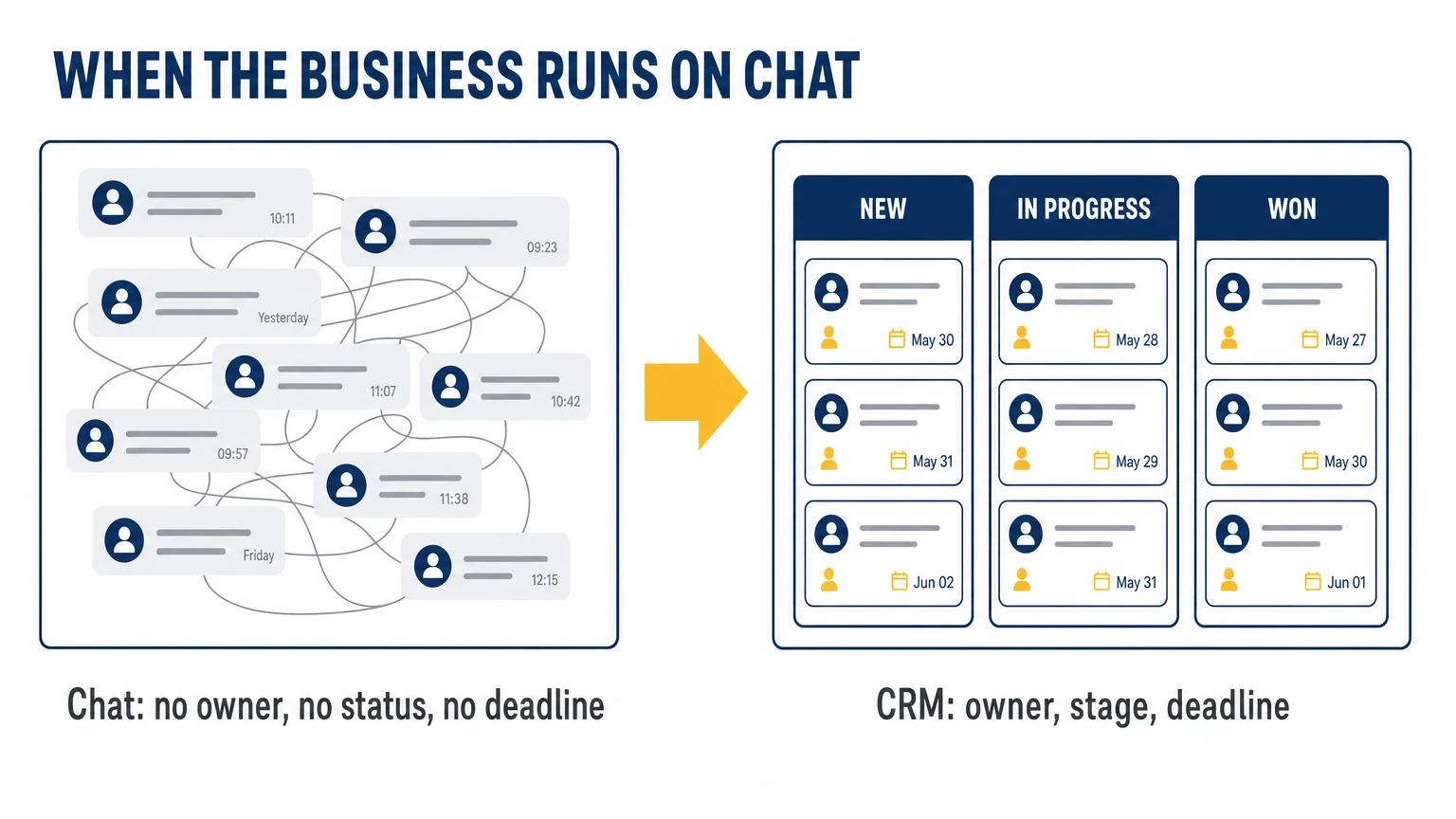
1. Nothing has an owner
A request lands in a group chat. Three people see it, each assumes another will handle it, and it falls through. Or two people do it twice. There is no owner, no due date, no status — just a message that scrolled away by lunch.
The fix: every request becomes a task with one owner, a deadline and a status. The group chat stays for talk; the work lives where it can be tracked. We usually wire this into Bitrix24 Tasks (or Uspacy) — the system the team already opens — so it is one workspace, not a new app to ignore.
2. The status update is a meeting
Because nothing is visible, the only way to know where things stand is to ask. So the day fills with “any update?” pings and a stand-up that exists purely to read out what a board would have shown in five seconds.
The fix: one shared board per team or project. Anyone can see what is in progress, what is blocked and what is done — without pinging a soul. The stand-up shrinks to the things that actually need a human.
3. Handoffs vanish between people
Sales closes a deal and tells production “in the chat”. Onboarding starts whenever someone happens to scroll back far enough. The handoff between two people — or two departments — is the single most expensive gap in most businesses, and chat hides it perfectly.
The fix: handoffs become automated transitions. A closed deal opens the next task for the right person, with the context attached. No one has to remember to forward anything.
4. Client promises live in someone's head
“I told them we would call Thursday.” Where is that written? In a one-to-one chat on a personal phone. The person goes on holiday, the promise goes with them, and the client churns politely.
The fix: client-facing commitments sit on the client record as tasks with reminders. The promise outlives the mood, the holiday and the staff turnover.
5. Onboarding a new hire means reading six months of chat
There is no process written down — the process IS the chat history. A new hire is productive in week six instead of week two, because everything they need to know is buried in scrollback nobody can search.
The fix: the recurring work becomes templates — checklists and task sequences that fire on their own. The new hire follows the board, not the legend of what Igor usually does.
What's the pattern?
Chat is a great place to talk and a terrible place to run a business, because it has no memory and no accountability. The goal is not to ban it — people like it because it is fast. The goal is to move the three things chat is worst at — ownership, status and handoffs — onto a board, and leave the talking where it belongs.